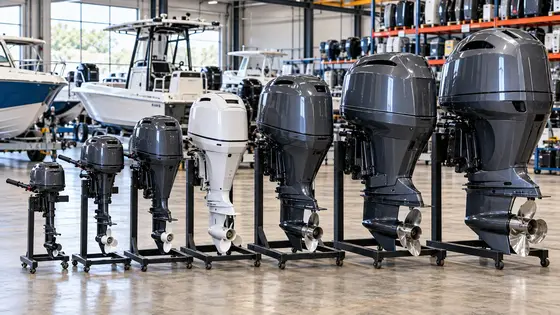
The right outboard motor size is set first by the boat's maximum horsepower rating on its capacity plate, then by weight and use: a planing hull typically needs about 1 hp for every 25 to 40 lb of fully loaded boat weight, and many dealers recommend choosing 70 to 90 percent of the maximum rating. As a rough guide, 12 to 14 ft aluminum boats use 9.9 to 25 hp, 16 to 18 ft runabouts 60 to 115 hp, and 20 ft and larger boats 150 hp and up.
Key takeaways
- Never exceed the maximum horsepower on the boat's capacity plate; in the US the plate is required on monohull boats under 20 ft, excluding sailboats, canoes, kayaks and inflatables.
- The US Coast Guard calculates maximum horsepower from boat length multiplied by transom width, under 33 CFR 183.53.
- For planing hulls, a common rule of thumb is 25 to 40 lb of loaded weight per horsepower; the lower the ratio, the faster the boat.
- Displacement hulls, such as sailboats and heavy workboats at low speed, need far less power because they cannot go much faster than their hull speed.
- Heavy loads, water sports, rough water and commercial duty all push the choice toward the upper end of the rated range.
- Motor weight and shaft length matter as much as horsepower; check the transom's weight limit and height.
What does the capacity plate tell me?
The capacity plate states the maximum horsepower, the maximum number of persons and the maximum weight the boat can safely carry. It is the legal and practical upper limit for outboard motor size, and in most cases the starting point for selection.
In the US, 33 CFR part 183 requires a capacity plate on monohull boats under 20 ft designed for outboard power, with sailboats, canoes, kayaks and inflatable boats excluded. Larger boats usually carry a builder's plate or a rating in the owner's manual. Operating above the rating is unsafe, may break state law depending on where you boat, and can void insurance cover. Outside the US, builders certifying under the EU Recreational Craft Directive or ISO 11592 also state a maximum propulsion power.
How is maximum outboard horsepower calculated?
The USCG formula starts with a "factor": boat length in feet multiplied by maximum transom width in feet. Small factors use a fixed table; larger ones use a formula that depends on steering and hull type.
| Factor (length x transom width) | Maximum horsepower |
|---|---|
| 35 or less | 3 hp |
| 36 to 39 | 5 hp |
| 40 to 42 | 7.5 hp |
| 43 to 45 | 10 hp |
| 46 to 52 | 15 hp |
| Over 52.5, remote steering and transom at least 20 in | 2 x factor minus 90 |
| Over 52.5, flat-bottom hard-chine, tiller or low transom | 0.5 x factor minus 15 |
| Over 52.5, other hulls, tiller or low transom | 0.8 x factor minus 25 |
Results that are not a multiple of 5 may be rounded up to the next multiple of 5. For example, a 16 ft boat with a 6 ft transom has a factor of 96; with remote steering and a 20 in transom, the rating is 2 x 96 minus 90 = 102, rounded up to 105 hp. A 14 ft flat-bottom jon boat with a 4.5 ft transom has a factor of 63, giving 0.5 x 63 minus 15 = 16.5, rounded up to 20 hp. The builder's plate always overrides your own estimate.
What outboard motor size do I need for my boat type?
For outboard motor size, most boats perform best at 70 to 90 percent of their maximum rating. The table gives typical ranges; actual needs vary with hull design, load and the builder's rating.
| Boat type | Typical length | Typical outboard size | Notes |
|---|---|---|---|
| Inflatable dinghy or tender | 8–12 ft | 2–15 hp | Check the inflatable's own maximum rating |
| Jon boat | 12–16 ft | 9.9–40 hp | Flat bottoms have lower ratings than V-hulls |
| Aluminum V-hull fishing boat | 14–18 ft | 15–90 hp | 25 to 60 hp is common for 16 ft hulls |
| Runabout or bowrider | 16–20 ft | 60–150 hp | Water sports push toward the top of the rating |
| Pontoon boat (two tubes) | 18–24 ft | 40–115 hp | Enough for cruising and fishing |
| Tritoon (three tubes) | 20–26 ft | 115–300 hp | Needed for planing and towing |
| Center console or bay boat | 18–24 ft | 90–300 hp | Larger hulls often run twin engines |
| Offshore center console | 25 ft and up | 200 hp and up, often twins | Multiple engines for redundancy |
| Small sailboat auxiliary | 18–26 ft | 3–9.9 hp | Displacement hull, long or extra-long shaft |
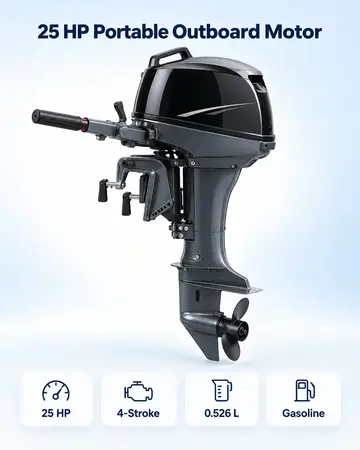
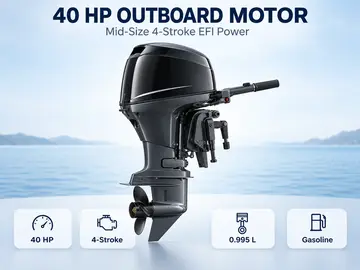
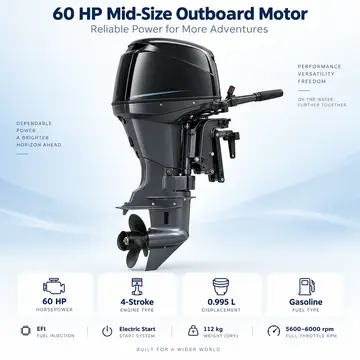
A 25 or 30 hp outboard such as the 25 hp EFI portable is a common fit for 14 to 16 ft aluminum boats and small jon boats, while 40 to 60 hp suits heavier 16 to 17 ft fishing boats and small pontoons. A 60 hp EFI four-stroke is a frequent choice for workboats, tenders and two-tube pontoons in the 18 to 22 ft range.
How do I use the weight-to-horsepower rule?
For planing hulls, divide the total loaded weight by a target ratio. Use 25 to 40 lb per hp as a starting range: around 40 lb per hp gives modest performance, and around 25 lb per hp gives brisk acceleration and higher top speed.
To estimate, add up:
- The dry weight of the hull.
- The weight of the motor, battery and rigging.
- Fuel, at roughly 6 lb per US gallon of gasoline.
- People, using a realistic figure such as 175 to 200 lb each.
- Gear, coolers, ice, live-well water and anything else carried regularly.
For example, a pontoon weighing 3,000 lb loaded needs roughly 75 hp at 40 lb per hp, or 120 hp at 25 lb per hp. If the result is above the plate rating, the plate wins, and the load must come down instead.
Do displacement and slow boats need less power?
Yes. A displacement hull pushes water aside rather than climbing on top of it, so its practical top speed is limited to roughly 1.34 times the square root of the waterline length in feet, in knots. Extra power beyond that point mostly makes waves and burns fuel.
For sailboat auxiliaries, small displacement workboats and trolling, the goal is enough thrust to hold hull speed against wind and current, not to plane. That is why many 20 to 26 ft sailboats use a 4 to 9.9 hp long-shaft motor. If a boat needs to plane, however, too little power is worse than too much: an underpowered motor runs at full throttle constantly, wears faster and can struggle to get on plane with a full load.
Should a commercial or rental boat use more or less power?
Commercial and rental boats usually benefit from sizing near the upper end of the rating. A motor that cruises at 60 to 75 percent throttle runs cooler and lasts longer than one held near wide-open throttle all day, and it keeps performance acceptable when the boat is overloaded with passengers or gear.
There are limits. Rental operators often derate deliberately to keep inexperienced drivers at safe speeds, and engines heavier than the transom was designed for can upset trim. Fleet operators also tend to standardize on one or two power ratings to simplify parts and training, as covered in our guide to choosing outboard motors for rental boat fleets.
Single or twin outboards?
A single outboard is cheaper to buy, lighter and more fuel efficient for the same total power. Twin outboards add redundancy, which is why they are common on offshore and commercial boats, and they improve low-speed handling.
As a guide, boats up to about 22 to 24 ft usually run a single engine, while larger offshore boats commonly run twins, triples or more. The largest production outboards now reach about 600 hp from V12 engines, though most commercial buyers choose more widely supported ratings between 90 and 300 hp, such as a 150 hp four-stroke. Whatever the horsepower, also confirm the correct shaft length with our outboard shaft length guide.
What should I send a supplier to size an outboard?
To size an outboard accurately, send the boat's length, transom width and height, dry weight, capacity plate rating, hull type, typical load and use, and steering type. Photos of the transom and capacity plate help. MARS reviews these details before quoting and ships outboards FOB or CIF Shanghai in export wooden boxes. Request a matched quotation.
Frequently asked questions
How big of an outboard do I need for a 16 ft boat?
Most 16 ft aluminum or fiberglass boats are rated somewhere between about 25 and 90 hp, depending on hull type and transom width. Choose within the plate rating, typically 70 to 90 percent of the maximum.
What size motor do I need for a pontoon boat?
A two-tube pontoon of 18 to 24 ft typically uses 40 to 115 hp for cruising and fishing, while tritoons that need to plane or tow commonly use 115 to 300 hp. Follow the pontoon's maximum rating.
Is it illegal to put a bigger motor on a boat than the capacity plate allows?
Exceeding the rated horsepower is unsafe and, depending on the state or country, may be illegal or void your insurance. Treat the plate rating as an absolute limit.
What size outboard do I need for a jon boat?
Most 12 to 14 ft jon boats run 9.9 to 25 hp, and 16 to 18 ft jon boats commonly run 25 to 60 hp. Flat-bottom hulls carry lower ratings than V-hulls of the same size.
Does a bigger outboard burn more fuel?
Not always. A larger motor uses more fuel at full throttle, but it may cruise at a lower throttle setting and use similar or even less fuel than an overworked small motor. Compare fuel curves at your typical cruising speed.
Is a 2-stroke or 4-stroke better for my outboard size?
For most sizes, a four-stroke is the better choice for fuel economy and emissions, while a two-stroke saves weight. See our comparison of 2-stroke vs 4-stroke outboards.