In the 2 stroke vs 4 stroke outboard decision, a modern four-stroke is the better choice for most boats: it burns less fuel, runs quieter, needs no oil in the fuel and meets current US and EU emission rules. A two-stroke is lighter, mechanically simpler and quicker to accelerate, which still makes it attractive for small, light boats and for markets where carbureted two-strokes remain legal and parts are easy to find.
Key takeaways
- A two-stroke fires once per crankshaft revolution; a four-stroke fires once every two revolutions and has a valve train, a separate oil sump and more moving parts.
- Carbureted two-strokes lose part of the fresh fuel charge out of the exhaust port, so they typically use noticeably more fuel and emit far more hydrocarbons than a four-stroke of the same power.
- Since model year 2010, new outboards sold in the US must meet EPA exhaust standards (40 CFR part 1045) that conventional carbureted two-strokes cannot meet; direct-injection two-strokes and four-strokes can.
- Two-strokes are lighter at the same horsepower and have strong low-speed torque, which matters most on portable motors and light planing hulls.
- Four-strokes need regular engine oil and filter changes and valve-clearance checks; two-strokes need a steady supply of two-stroke oil, either premixed or injected.
- For rental and commercial fleets, fuel cost, noise complaints and waterway restrictions usually tip the decision toward four-strokes.
What is the difference between a 2-stroke and a 4-stroke outboard?
The difference is how many piston strokes it takes to complete one power cycle. A two-stroke completes intake, compression, power and exhaust in two strokes (one crankshaft revolution), while a four-stroke uses four strokes (two revolutions) and separates each phase with poppet valves.
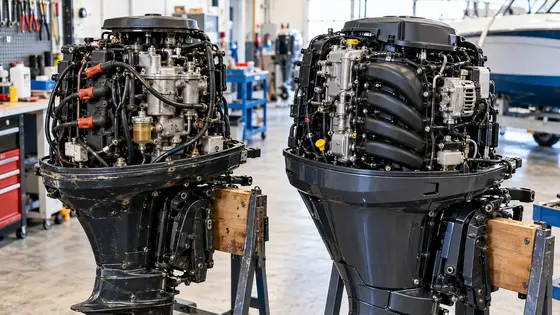
In a traditional two-stroke outboard, the fuel-air-oil mixture is drawn into the crankcase, then pushed into the cylinder through transfer ports while exhaust gas leaves through the exhaust port. There are no valves, camshaft or timing belt. Because the crankcase carries fuel mixture, it cannot hold an oil sump, so lubricating oil must be mixed with the fuel or metered into it by an oil-injection pump.
A four-stroke outboard works like a car engine laid on its side, with a vertical crankshaft. It has intake and exhaust valves driven by one or two camshafts, a wet sump with an oil pump and filter, and usually electronic fuel injection on all but the smallest models. The result is more parts and more weight, but much cleaner combustion.
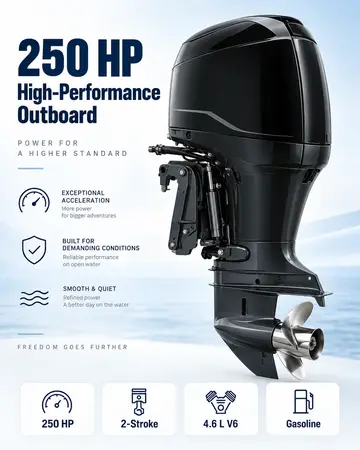
A third design sits between them: the direct-injection (DFI) two-stroke. It injects fuel straight into the cylinder after the exhaust port has closed, so very little unburned fuel escapes. DFI two-strokes such as the 250 hp OptiMax-type outboard keep the two-stroke's light weight and punch while meeting modern emission rules.
2-stroke vs 4-stroke outboard comparison table
The table summarizes the typical 2 stroke vs 4 stroke outboard differences between engines of similar horsepower. Exact figures vary by model, so always compare data sheets.
| Factor | Carbureted 2-stroke | Direct-injection 2-stroke | 4-stroke (EFI) |
|---|---|---|---|
| Power strokes | Every revolution | Every revolution | Every second revolution |
| Weight at same hp | Lightest | Light | Heaviest |
| Fuel economy | Poorest, especially at low speed | Close to 4-stroke | Best in most conditions |
| Exhaust emissions | High hydrocarbons and smoke | Meets current EPA rules | Meets current EPA and EU rules |
| Noise and idle | Loud, rougher idle | Moderate | Quietest, smoothest idle |
| Lubrication | Premix or oil injection | Oil injection | Separate sump, oil changes |
| Mechanical complexity | Simplest | Complex electronics | Valves, cams, more parts |
| Typical availability | Some export markets only | Limited | Widest range, 2.5 to 400+ hp |
Is a 2-stroke or 4-stroke outboard better on fuel?
A four-stroke is better on fuel in almost every case. In a carbureted two-stroke, the incoming mixture helps sweep exhaust gas out of the cylinder, and some of it escapes unburned; buyer guides commonly cite roughly 15 to 30 percent higher fuel use than an equivalent four-stroke, with the gap largest at trolling and idle speeds.
Direct-injection two-strokes close most of that gap, and at wide-open throttle some are competitive with four-strokes. For a boat that runs many hours per year, such as a ferry tender, a dive boat or a rental fleet, fuel is often the largest running cost, so even a modest efficiency difference adds up quickly. Two-strokes also burn oil continuously, which is an extra consumable to budget for.
Which is more reliable and easier to maintain?
Both designs can be very reliable; the difference is in what needs attention. A carbureted two-stroke has fewer moving parts and is easier to repair with basic tools, which is why it remains popular in remote fishing communities. A four-stroke has more parts but very long service intervals when maintained to schedule.
Typical maintenance differences:
- Oil: a four-stroke needs engine oil and filter changes, commonly every 100 hours or once a year; a two-stroke needs a constant supply of two-stroke oil (NMMA TC-W3 grade is the usual specification) at the correct ratio.
- Valve train: four-strokes need periodic valve-clearance checks and, on some models, timing belt inspection or replacement.
- Spark plugs: two-strokes tend to foul plugs faster, especially when idled for long periods.
- Carbon and fuel: carbureted engines are sensitive to stale fuel and varnish; EFI four-strokes are sensitive to water in fuel and need good filtration.
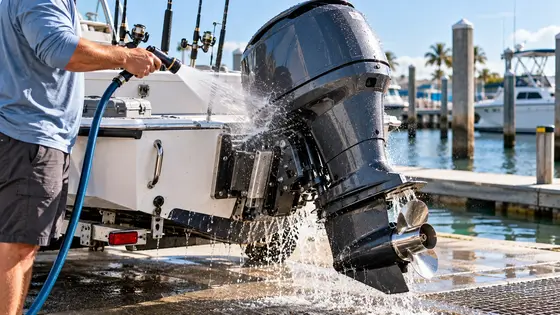
- Shared items: both need gear oil changes, water-pump impeller replacement, anode checks and greasing, usually on a 100-hour or annual cycle.
A full checklist for both types is in our outboard maintenance and winterizing guide.
Are 2-stroke outboards still legal?
Yes, but new conventional carbureted two-strokes can no longer be sold in the US or EU. Since model year 2010, US outboards must meet EPA exhaust standards under 40 CFR part 1045, and the EU Recreational Craft Directive 2013/53/EU sets similar limits for engines placed on the EU market. Direct-injection two-strokes and four-strokes are certified to these rules.
Owners can generally keep running older two-strokes, but some waterways restrict them. Several protected lakes and drinking-water reservoirs limit or ban carbureted two-strokes, and Lake Tahoe has prohibited most carbureted two-stroke engines since 1999. In many export markets in Africa, Southeast Asia, the Pacific and Latin America, carbureted two-strokes are still sold new, mainly for small fishing boats.
Which should a fleet operator or distributor choose?
For most commercial buyers in regulated markets, the 2 stroke vs 4 stroke outboard question has a simple answer: a four-stroke is the default. Lower fuel use, quieter running for passengers and guests, no premix mistakes by renters and unrestricted access to waterways outweigh the higher purchase price and weight. Standardizing on one four-stroke EFI family, as on the 60 to 115 hp EFI outboard fleet project, also keeps spare parts and mechanic training simple.
A two-stroke still makes sense when:
- The boat is very light, such as a small skiff or a canoe-stern dinghy, and weight on the transom is critical.
- The motor will be repaired locally by mechanics familiar with two-strokes, far from dealer networks.
- The market still allows carbureted two-strokes, the fuel supply is variable and simple carburetion is preferred.
- High acceleration and power-to-weight matter more than fuel cost, as in some performance and racing use.
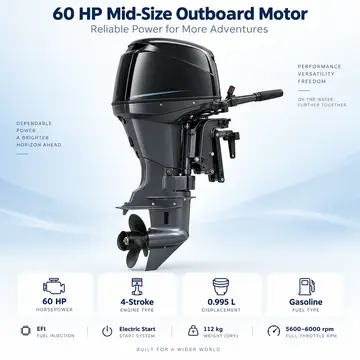
For mid-range power, popular four-stroke choices include the 60 hp EFI four-stroke for workboats and tenders. Compare the full range on the outboard motors page.
Does a 2-stroke or 4-stroke cost more to own?
A four-stroke usually costs more to buy and less to run. Purchase price is higher because of the extra mechanical parts and fuel-injection electronics, and the motor is heavier, which can affect transom and boat choice. Running costs are lower because of reduced fuel and oil consumption.
Whether the higher price pays back depends on annual hours. A private owner running 50 hours a year may never recover the difference through fuel alone, while a rental or commercial boat running several hundred hours a year often does within a few seasons. Resale value also tends to favor four-strokes in markets where two-strokes are restricted. For a broader look at price drivers, see outboard motor prices, new vs used.
MARS supplies four-stroke and direct-injection outboards for export, with motors checked before dispatch and packed in export wooden boxes, shipped FOB or CIF Shanghai. To compare options for a specific hull or fleet, send your requirements.
Frequently asked questions
Is a 4-stroke outboard heavier than a 2-stroke?
Yes. At the same horsepower, a four-stroke is normally heavier because of its valve train, oil sump and fuel-injection system. Always check the boat's maximum engine weight and transom rating before switching.
Can I run a 2-stroke outboard without oil in the fuel?
No. A two-stroke relies on oil carried in the fuel, either premixed or injected, to lubricate the crankshaft, bearings and cylinder walls. Running without oil can seize the engine within minutes.
What oil ratio does a 2-stroke outboard use?
Many premix outboards use 50:1 fuel to oil, but some older or smaller models use other ratios, and oil-injected engines meter oil automatically. Always follow the owner's manual and use TC-W3 two-stroke outboard oil.
Are 2-stroke outboards louder than 4-strokes?
Generally, yes. Carbureted two-strokes are louder and rougher at idle, while four-strokes are noticeably quieter, especially at trolling speed.
How do I winterize a 2-stroke outboard motor?
Add fuel stabilizer and run it through, fog the cylinders with fogging oil, drain the carburetor float bowls, change the gear oil, grease the fittings and flush the cooling system. Store the motor upright in a dry place.
Is a direct-injection 2-stroke the same as an old 2-stroke?
No. A direct-injection two-stroke injects fuel into the cylinder after the exhaust port closes, cutting fuel loss and emissions to levels that meet current rules. It is more complex electronically than a carbureted two-stroke.