Buying a used jet ski safely comes down to six checks: matching paperwork and hull identification number (HIN), engine hours backed by service records, a cold start and compression test, the jet pump and driveline, the hull and electrics, and a water test at full throttle. Well-maintained four-stroke personal watercraft (PWC) commonly run 300–500 hours or more before major engine work, while older two-strokes typically need top-end work at around 200–300 hours. Price should follow condition and history, not just model year.
Key takeaways
- Check that the HIN on the hull matches the title or registration; under 33 CFR 181.25, a US HIN has 12 characters with no spaces or hyphens.
- Hours are a guide, not a verdict: four-strokes commonly reach 300–500+ hours with good care, and two-strokes about 200–300 hours before top-end work.
- A compression test and a diagnostic scan of stored fault codes reveal more about engine health than the hour meter alone.
- Inspect the jet pump intake, impeller and wear ring; a worn wear ring causes weak acceleration that is often mistaken for engine trouble.
- Saltwater use, missed flushing and poor winter storage age a PWC faster than hours alone suggest.
- Used jet ski values depend on model, hours, records and condition; valuation guides are only a starting point.
What should I look for when buying a used jet ski?
When buying a used jet ski, look first for evidence of care: service records, a clean hull, a dry engine bay and a seller who can explain how the craft was used and stored. A clean, documented machine with moderate hours is usually a better buy than a low-hour machine with no history.
Ask the seller these questions before you travel to see it:
- How many hours are on the meter, and are there service invoices?
- Was it used in saltwater, and was it flushed after every ride?
- How was it stored and winterized?
- Has it had any engine, pump or supercharger work, and who did it?
- Has it ever sunk, been submerged or been in a collision?
- Is the title or registration in the seller's name, with no lien?
Then arrange to see it cold, on its trailer, with time for a water test.
How long do jet skis last?
Jet skis commonly last about 300–500 hours for four-stroke engines and about 200–300 hours for two-strokes before major engine work, assuming reasonable maintenance. Many well-maintained four-strokes exceed those figures, while neglected machines can fail much sooner.
Recreational owners often ride somewhere in the region of 30 hours a year, so a ten-year-old ski with 300 hours has had a typical life. A three-year-old ex-rental machine might have similar hours with very different wear: many short sessions, beach landings and inexperienced riders, but also regular professional servicing. Treat high hours as a reason to inspect more closely rather than an automatic no.
| Factor | Lowers risk | Raises risk |
|---|---|---|
| Water type | Freshwater use | Saltwater without regular flushing |
| Service history | Dated invoices, oil changes on schedule | No records, owner "did it myself" with no detail |
| Storage | Covered, winterized, fogged where required | Outdoors, uncovered, left with stale fuel |
| Engine type | Naturally aspirated four-stroke | High-hour supercharged engine with no supercharger records |
| Riding area | Open, deep water | Shallow, sandy launches and beaching |
| Hours vs age | Steady use each season | Very low hours after long idle periods |
What are high hours on a jet ski?
For a four-stroke, many buyers start inspecting more closely once the meter passes about 200–300 hours; for a two-stroke, from about 150–200 hours. Those are inspection triggers, not limits. A compression test, records and a water test decide whether the hours are a problem.
Used jet ski inspection checklist
Use this checklist on every used watercraft, and bring a flashlight, a compression gauge and, ideally, a technician with the right diagnostic tool.
1. Paperwork and identity
- Compare the HIN on the transom with the title, registration and bill of sale.
- Check for signs the HIN plate or molding has been altered.
- Confirm there is no outstanding loan or lien where your jurisdiction allows a check.
- Ask for service invoices, the owner's manual and both keys or lanyards.
2. Hull, deck and seat
- Look under the hull for deep gouges, cracks, fresh gelcoat patches or fiberglass repairs.
- Check the bond line where hull and deck join for separation.
- Inspect the seat, latches and storage compartments for cracks and water marks.
- Look at the ride plate and sponsons for impact damage.
3. Engine bay
- Remove the seat and check for water, oil residue, corrosion and a fuel smell.
- Inspect hoses, clamps and the exhaust system for cracks, salt crust or leaks.
- Check oil level and condition on four-strokes; milky oil suggests water ingress.
- Look for a rust line or debris high in the bay, which can indicate the craft has been submerged.
4. Cold start and compression
- Ask for the engine to be cold when you arrive, so starting problems are not hidden.
- Listen for knocking, rattles or uneven idle.
- Run a compression test; a common rule of thumb is that readings should be within about 10% of each other across cylinders, and within the manufacturer's specified range.
- Have stored fault codes and engine data read with the manufacturer's diagnostic tool where possible; it can also confirm the true hours.
5. Jet pump and driveline
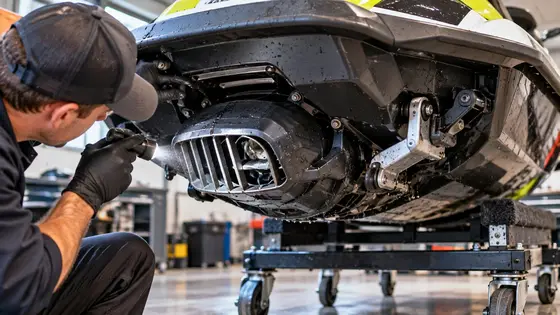
- Check the intake grate for damage and the impeller blades for nicks, bends or wear.
- Check the gap between impeller and wear ring against the manufacturer's spec.
- Inspect the driveshaft seal area (a carbon ring seal on some models) for leaks.
- Turn the steering and check the nozzle and reverse gate move smoothly.
6. Supercharger, if fitted
- Ask for evidence of supercharger inspection or rebuild at the manufacturer's interval.
- Treat a high-hour supercharged ski without these records as a higher-risk purchase and price it accordingly.
7. Water test
- Check for an easy start, a smooth idle and clean shifting in and out of reverse.
- Accelerate hard: hesitation or cavitation can point to a worn pump or a damaged impeller.
- Hold full throttle long enough to check temperature and any warning lights.
- After the run, lift the seat and check the bilge for water.
8. Trailer
- Check tires, wheel bearings, lights, rollers or bunks, the winch strap and rust on the frame.
- Confirm the trailer has its own registration where required.
Common used jet ski problems and red flags
Most problems on used PWC come from water ingress, pump wear and neglect. The table lists common symptoms and likely causes; confirm any diagnosis with a qualified technician.
| Symptom | Likely causes | What to do |
|---|---|---|
| Weak acceleration, high rpm without speed | Worn wear ring, damaged impeller, intake blockage | Inspect pump; factor in parts and labor |
| Water in the bilge after riding | Driveshaft seal, hull crack, hose or exhaust leak | Find the source before buying |
| Overheating warning | Blocked cooling passages, salt buildup, debris | Ask about flushing; have the system checked |
| Milky oil | Water ingress into the engine | Walk away unless the price reflects a rebuild |
| Low or uneven compression | Ring, valve or head gasket wear | Get a repair estimate or walk away |
| Fault codes or limp mode | Sensor, wiring or engine faults | Scan with the dealer diagnostic tool |
How much is a used jet ski worth?
A used jet ski is worth what its model, hours, condition and records support in your local market. Published valuation guides for powersports give a baseline by model and year, but they assume average condition and do not see the service history or the inspection result.
As a broad, indicative US guide, older two-stroke machines may sell for under $2,000, while well-kept four-strokes around six to eight years old commonly trade around $5,000–10,000. Late-model supercharged and luxury models sit higher. Adjust for:
- Hours above or below average for the age.
- Missing service records.
- Repairs needed after inspection, priced at local dealer rates.
- Whether a trailer, cover and safety equipment are included.
New-unit pricing is covered in how much a jet ski costs, which helps you judge whether a nearly new used machine really saves money.
What is the best used jet ski to buy?
The best used jet ski for most buyers is a naturally aspirated four-stroke recreation model with full service records, freshwater history and a strong local dealer network for parts. These machines are simpler and cheaper to maintain than supercharged models. Popular models also tend to have better parts availability.
If you are unsure which class suits you, read our guide to personal watercraft types first. After purchase, budget for an immediate service: oil and filter, spark plugs, a battery check and a pump inspection, then follow a regular schedule such as the one in our PWC fleet maintenance schedule.
Should a rental fleet buy used or new?
For resorts and rental operators, new units are usually easier to justify. They come with a warranty and known history, and a fleet can be bought as matching models. Used machines can fill short-term gaps, but mixed hours and histories complicate maintenance planning. MARS supplies new personal watercraft for fleets, such as the 170 hp recreation model, with a machinery check, written report and video before dispatch.
Frequently asked questions
How many hours does a jet ski last?
A well-maintained four-stroke jet ski commonly lasts about 300–500 hours or more before major engine work. Older two-strokes typically need top-end work at around 200–300 hours.
Is 100 hours a lot on a jet ski?
No. For a modern four-stroke, 100 hours is low to moderate use, often equal to a few seasons of private riding. Condition and maintenance history still matter more than the number.
Should I buy a used jet ski that was used in saltwater?
You can, but inspect it more carefully. Look for corrosion in the engine bay, salt buildup in the cooling system and evidence that it was flushed after every ride.
Is buying a used supercharged jet ski a good idea?
It can be, but only with records showing supercharger service at the manufacturer's interval. Without them, budget for an inspection or rebuild and negotiate the price accordingly.
How do I check a jet ski's real hours?
The display shows hours on most modern PWC, and a dealer diagnostic scan can confirm the engine's recorded hours and history. Compare these with service invoices.
What maintenance does a used jet ski need right after purchase?
Plan an oil and filter change on four-strokes, new spark plugs, a battery test, a pump and impeller inspection and a check of hoses and clamps. That gives you a known baseline for future servicing.
Replacing aging rental units with new machines? Tell us your fleet size and models and we will quote.