The right outboard for a commercial or rental fleet is an EFI four-stroke sized inside the hull's rated maximum horsepower, with a shaft length that matches the transom height, chosen from as few models as possible. Standardizing on one or two engine models per fleet cuts spare-parts stock, simplifies training and keeps boats earning when something breaks. Brand choice matters less than local parts support and a disciplined maintenance plan.
Key takeaways
- Never exceed the maximum horsepower and weight on the boat's capacity plate; size engines for the loaded boat, not the empty one.
- Shaft length must match transom height: typically 15 in (short), 20 in (long) or 25 in (extra-long) on the engines most fleets use.
- EFI four-strokes start more easily, idle more smoothly and in most cases use less fuel than carbureted or older two-stroke engines, which suits rental duty.
- Standardizing on one or two models means one set of filters, impellers, anodes and propellers to stock.
- Plan a consumables kit per engine for at least one season before the boats go into service, especially in remote locations.
How much horsepower does a rental or work boat need?
Start with the capacity plate or builder's certificate. It states the maximum horsepower the hull is rated for, and installing more is unsafe and can create insurance and liability problems. Within that limit, most fleet operators aim for an engine that can plane the boat fully loaded (passengers, fuel, gear) without running at wide-open throttle all day.
An underpowered boat is a false economy. It runs at high rpm for long periods, struggles to get on plane with a full load and often burns more fuel than a slightly larger engine cruising at part throttle. A boat powered at the very top of its rating, on the other hand, can be more than inexperienced renters should handle. For rental work, a sensible target is usually somewhere between two-thirds of the rated maximum and the maximum itself, confirmed by a loaded sea trial.
| Typical boat (guide only) | Common fleet horsepower | Example models |
|---|---|---|
| Tenders, dinghies, small aluminum skiffs | 9.9–20 hp | Suzuki DF9.9BT EFI, Mercury 20 EFI |
| 4–5 m open boats and utility skiffs | 25–40 hp | Mercury 25 EFI, Mercury 30 EFI, Mercury 40 EFI |
| 5–6 m aluminum utility and patrol boats | 60–90 hp | Mercury 60 EFI, Suzuki DF90A |
| 6–7 m center consoles and pontoons | 90–150 hp | Suzuki DF90A, Mercury 115 ELPT, Mercury 150 EFI |
| 7 m+ offshore and larger rental boats | 200–300 hp | Suzuki DF225, Suzuki DF250, Mercury Verado 300 |
These bands are indicative only. Hull weight, deck layout, passenger count and sea conditions all shift the answer, so always check against the builder's rating and the engine manufacturer's data.
What shaft length do I need?
Shaft length is measured from the underside of the mounting bracket to the anti-ventilation plate, and it must match the transom height. If the shaft is too short, the propeller ventilates and the water intake can suck air; too long, and the gearcase adds drag and spray. In most cases:
- Short shaft (about 15 in / 381 mm): small tenders and dinghies.
- Long shaft (about 20 in / 508 mm): the majority of small and mid-size boats.
- Extra-long shaft (about 25 in / 635 mm): larger boats, many center consoles and most twin installations.
Suzuki, for example, offers the DF90A with a 508 mm (L) or 635 mm (X) shaft, and Mercury model codes such as "L" and "XL" follow the same logic. Measure every transom in the fleet before ordering, because two hulls from different builders with the same length can still need different shafts.
Why choose EFI four-stroke outboards for a fleet?
Electronic fuel injection with a four-stroke powerhead is now the standard choice for commercial and rental work. The practical benefits for an operator are:
- Reliable starting. EFI meters fuel electronically, so there is no choke to misuse, which matters when dozens of different customers start the engine each week.
- Fuel economy. Four-strokes do not burn oil in the fuel, and features such as Suzuki's Lean Burn Control are designed to improve economy at cruising speed.
- Smooth, quiet running. Guests notice less smoke, smell and noise, which is part of the rental experience.
- Diagnostics. EFI engines log running hours and fault codes that a dealer can read, which makes service planning and warranty claims easier.
EFI does have one requirement: clean fuel. Fit a water-separating fuel filter, buy fuel from a reliable source, and follow the manufacturer's advice on ethanol-blended fuel and storage. Remote stations with doubtful fuel quality should stock extra fuel filters.
Note that not every engine on the market is a four-stroke. Direct-injection two-strokes such as Mercury's OptiMax family are still found on older performance boats, but for a new rental or utility fleet a four-stroke is the simpler choice.
Mercury or Suzuki: which range fits my fleet?
Both brands build complete four-stroke ranges from portables to V6 and V8 engines, and both are well represented in commercial use. The better choice for your fleet usually comes down to which brand has dealer and parts support where the boats operate, what your mechanics already know, and what your boat builder rigs as standard.
| Horsepower band | Mercury models carried | Suzuki models carried |
|---|---|---|
| Portable (9.9–30 hp) | 20 EFI, 25 EFI, 30 EFI, 30ELGA EFI | DF9.9BT EFI |
| Mid-range (40–150 hp) | 40 EFI, 60 EFI, 115 ELPT, 150 EFI | DF90A |
| High horsepower (200–300 hp) | Verado 300 XL, Verado 300 CXL | DF225, DF250, DF300 |
A few practical points:
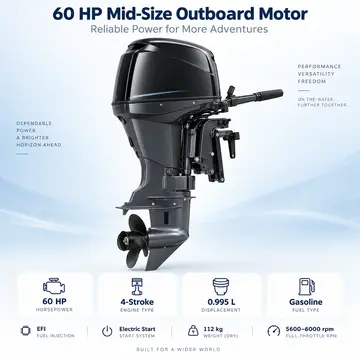
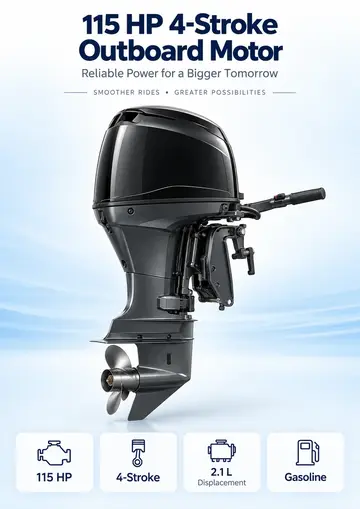
- Mercury's small and mid-range FourStrokes, such as the Mercury 60 EFI and the Mercury 115 ELPT, are common on aluminum work boats and patrol craft.
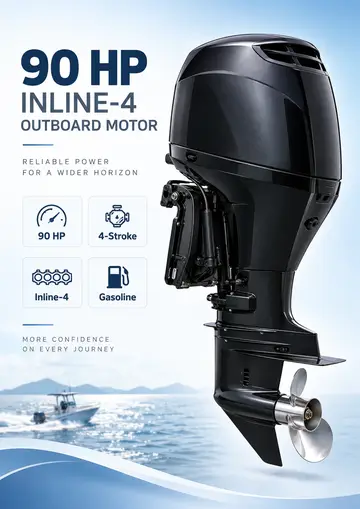
- The Suzuki DF90A is a 1,502 cc inline-four with multi-point EFI and Lean Burn Control, well suited to 6–7 m rental boats.
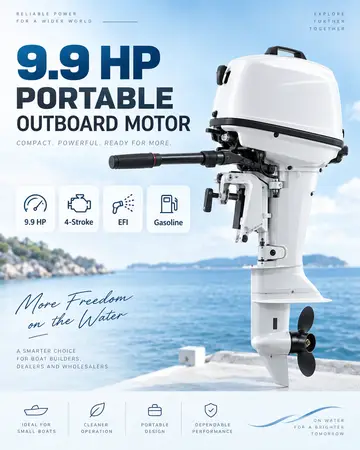
- For tenders and small boats, the Suzuki DF9.9BT EFI keeps the benefits of fuel injection in a portable package.
- Counter-rotating versions (Mercury's "C" models, for example) are needed on twin installations so the propellers turn in opposite directions.
Why standardize on one or two outboard models?
Every additional model in a fleet adds its own filters, impellers, spark plugs, anodes, propellers and possibly control cables. Standardizing lets a small workshop stock one set of parts, train mechanics once and swap engines between boats when one is out of service.
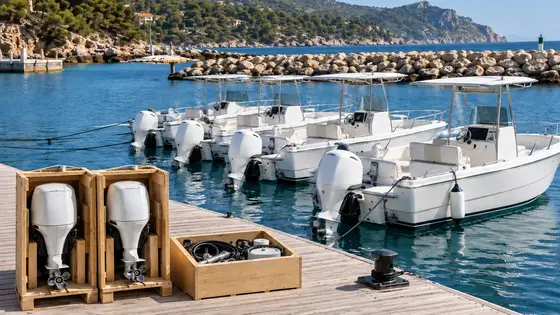
A common pattern is one model for the main rental boats and one portable model for tenders, chase boats or small craft. In a marina rental project in Croatia, the operator ran Suzuki DF90A engines on its 6 m and 7 m center consoles and DF9.9BT EFI engines on tenders, and later added DF225s for larger boats while staying within the same brand. A provincial authority in Papua New Guinea took a similar approach with twelve Mercury 60 EFI and six Mercury 115 ELPT outboards for its utility boats, supplied with matching rigging and consumables.
Standardization also applies to rigging. Use the same control boxes, cables, gauges and fuel-line fittings wherever possible, and keep propellers of the same diameter and pitch on identical hulls.
How should I plan spare parts for an outboard fleet?
Spares planning starts with the maintenance schedule in each engine's owner's manual. For most four-strokes the routine service items are engine oil and filter, gear lube, fuel filters, spark plugs, the water pump impeller and sacrificial anodes. A practical approach is to buy a consumables kit per engine for at least the first season, sized to the hours you expect to run.
Beyond consumables, rental fleets usually hold:
- Spare propellers. Renters hit sandbars and rocks; at least one spare prop per engine model is standard practice.
- Shear pins or prop hub kits, depending on the engine design.
- Kill-switch lanyards and clips, which are easily lost.
- Fuses, a spare battery and battery terminals.
- Thermostats, fuel-line primer bulbs and hoses for remote sites without a nearby dealer.
The more remote the operation, the deeper the stock needs to be, because a two-week wait for a part can cost a boat most of its peak-season earnings.
What should I check before ordering?
Before requesting a quotation, gather the following for each boat type:
- Hull length, weight and maximum rated horsepower from the capacity plate.
- Transom height, to confirm shaft length.
- Single or twin installation, and whether counter-rotation is needed.
- Steering type (tiller, mechanical or hydraulic) and remote control requirements.
- Typical load, daily running hours and operating water (salt or fresh).
- Delivery deadline relative to your season.
MARS supplies Mercury and Suzuki outboards as an independent supplier, with pre-delivery inspection, crated export packing and FOB or CIF shipment from Shanghai. For stock models or a fleet quotation, contact us with the details above.
Frequently asked questions
Can I fit a bigger outboard than the capacity plate allows?
No. The capacity plate or builder's rating sets the maximum safe horsepower and engine weight, and exceeding it can make the boat unsafe and create insurance and legal problems.
Is a long shaft or short shaft better?
Neither is better in general; the correct shaft length is the one that matches your transom height. Most small and mid-size boats use a long (about 20 in) shaft, while larger boats and twins often use extra-long (about 25 in).
Are four-stroke outboards more reliable than two-strokes for rental use?
Modern EFI four-strokes are the usual choice for rental work because they start easily, run cleanly and do not need oil mixed into the fuel. Reliability still depends mostly on correct installation and following the maintenance schedule.
How many engine models should a fleet run?
As few as possible. Many operators run one main model plus one portable model for tenders, which keeps the spare-parts stock and mechanic training manageable.
Should I choose Mercury or Suzuki?
Both offer complete four-stroke ranges. Choose the brand with the strongest dealer and parts support where your boats operate and the one your mechanics are trained on.
How long does delivery take?
Stock engines ship promptly, while built-to-order units typically take around 20 working days before dispatch, plus sea freight time to your port. Confirm timing against your season start when ordering.