To import marine engines from China without surprises, you need five things in place: a written specification the supplier confirms line by line, an agreed Incoterm (usually FOB or CIF from a Chinese port), a documented pre-shipment test with report and video, export-grade packing, and a complete document set for customs and class. Most delays and disputes come from gaps in the specification or the documents, not from the engine itself.
Key takeaways
- A marine engine enquiry should state rating, duty, speed, gearbox ratio, cooling, class society and emissions certificate needs, not just a model name.
- Under Incoterms 2020, FOB moves risk to the buyer once goods are on board the vessel, while CIF adds seller-paid freight and minimum insurance but moves risk at the same point.
- EXW puts export clearance and loading on the buyer, which is often impractical for overseas buyers without a China-based agent.
- A pre-shipment run test with a written report, video and serial-number record is the most useful single quality control step.
- The core shipping documents are the commercial invoice, packing list, bill of lading and certificate of origin, plus class and emissions certificates where required.
- Solid-wood packing for international shipment generally has to comply with ISPM 15 (heat treated or fumigated and marked).
What should a marine engine specification include?
"One 6-cylinder marine diesel, about 300 hp" is not a specification. The same engine family can come in different ratings, cooling systems and flywheel housings, and those details decide whether it fits your boat. Before asking for a price, write down:
| Item | Why it matters |
|---|---|
| Power rating and rated speed (kW/hp at rpm) | Must match the hull, duty and propeller; marine ratings differ from industrial and genset ratings |
| Duty classification (continuous, heavy, medium, light) | Determines permissible load profile and warranty conditions |
| Application (propulsion, auxiliary, genset) | Genset engines run at fixed 1500/1800 rpm; propulsion engines need a gearbox and variable speed |
| Gearbox model and reduction ratio | Must suit the propeller diameter and pitch, and the shaft line |
| Cooling (heat exchanger, keel cooling, radiator) | Affects installation, sea water system and spares |
| Flywheel housing / flange (SAE size) | Must match gearbox or alternator |
| Class society certificate (CCS, BV, ABS, DNV, LR, RS, etc.) | Required if the vessel is classed; must be ordered before production |
| Emissions certificate | Marine diesels above 130 kW on ships under MARPOL Annex VI generally need an EIAPP certificate; national rules may also apply |
| Starting system and voltage (12/24 V, electric or air start) | Must match the vessel electrical system |
| Instrument panel, alarms, harness length | Often forgotten, then ordered separately |
| Spare parts kit and hours covered | Easier to include in the first shipment |
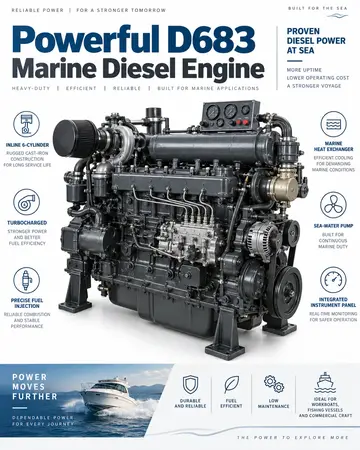
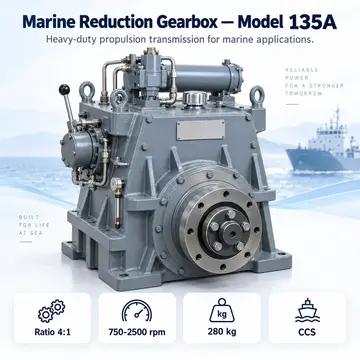
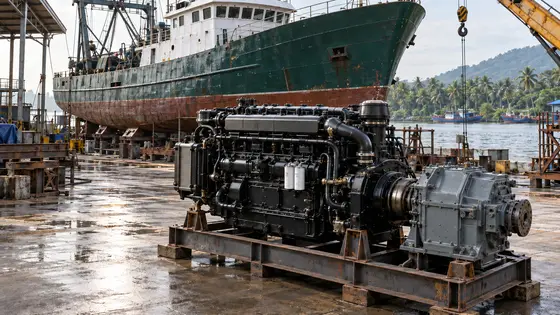
If you are replacing an engine, send the nameplate photo, current gearbox data, propeller size and a photo of the engine bed. An engineering-led supplier should confirm engine and gearbox matching in writing before you pay a deposit. In our fishing trawler repower project, the SDEC D683 marine diesel and an Advance 135A gearbox at 4:1 were matched to the existing shaft line and propeller. They were then run-tested together before packing.
FOB, CIF or EXW: which Incoterm should you use?
Incoterms are the International Chamber of Commerce rules that define who pays for what and where risk passes. The current edition is Incoterms 2020. Always write the edition and named place in the contract, for example "FOB Shanghai, Incoterms 2020".
| Term | Seller's responsibility | Risk passes to buyer | Best for |
|---|---|---|---|
| EXW (Ex Works) | Makes goods available at its premises | When goods are made available, not loaded | Buyers with their own China agent handling export clearance |
| FOB (Free On Board) | Export clearance and loading on board the buyer's nominated vessel | When goods are on board at the port of shipment | Buyers with a freight forwarder and good ocean rates |
| CIF (Cost, Insurance and Freight) | FOB duties plus ocean freight and minimum cargo insurance to the destination port | When goods are on board at the port of shipment, as with FOB | Buyers who want a single delivered-to-port price |
Three points are commonly misunderstood:
- CIF does not move risk to the destination. The buyer carries transit risk and claims against the insurance. Under Incoterms 2020, CIF only requires minimum cover (Institute Cargo Clauses C), so ask for broader cover if you need it.
- EXW makes the buyer the exporter. That is awkward for foreign buyers in China. Many choose FCA or FOB instead.
- FOB is designed for sea and inland waterway transport. For containerized cargo handed over at a terminal, the ICC suggests FCA may fit better, although FOB remains widely used in practice.
MARS quotes FOB or CIF from Shanghai. The choice mostly comes down to whether you or we get the better freight rate on your lane.
What should a pre-shipment inspection cover?
For engines and gearboxes, a visual check alone is not enough. Ask for:
- A run test at the supplier's or manufacturer's test bench, covering start-up, idle, load steps where the bench allows, and shutdown.
- A written test report listing engine model and serial number, gearbox serial, oil pressure, coolant temperature, rpm, any abnormal readings and the test date.
- A video of the test showing the nameplate and serial numbers, so the unit tested is clearly the unit shipped.
- A photo record of accessories, the spare parts kit and the packing before the box is closed.
- A serial-number list for batch orders, cross-checked against the packing list.
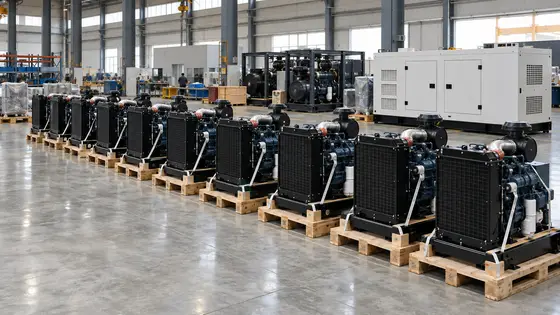
Some buyers also use a third-party inspection company or a class surveyor for classed engines. For batch orders like our genset assembler supply, a batch inspection with serial numbers tied to test reports simplifies warranty tracking later.
How should engines be packed for export?
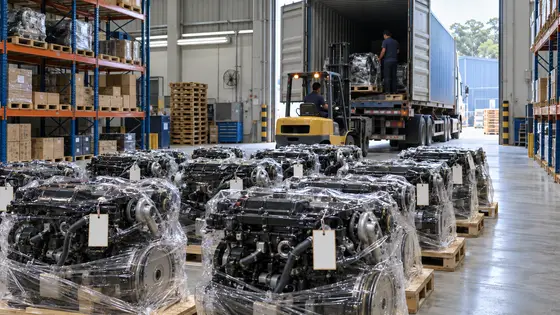
Engines travel as heavy, concentrated loads and are often transshipped. Good practice includes:
- Draining and preservation. Fluids are drained or inhibited as required, openings are sealed and exposed machined surfaces are protected.
- Export wooden boxes or steel frames. These should be bolted through the engine mounts, not just blocked in place.
- ISPM 15 compliance. Solid wood packing must be heat treated or fumigated and carry the IPPC mark. Processed wood such as plywood is generally exempt.
- Moisture control. Use a vapor barrier wrap and desiccant, especially for long voyages through the tropics.
- Marking. Mark gross weight, center of gravity, lifting points, "this way up" and the order reference.
- Container lashing. Secure the load so it cannot shift when a 20 ft or 40 ft container is lifted.
Which documents do you need to import engines?
| Document | Purpose |
|---|---|
| Commercial invoice | Basis for customs valuation; must show seller, buyer, description, HS code, quantity, unit price, Incoterm and currency |
| Packing list | Box-by-box contents, dimensions, net and gross weights, serial numbers |
| Bill of lading (B/L) | Carrier's receipt and contract of carriage; an original negotiable B/L also acts as document of title |
| Certificate of origin | Proves Chinese origin; a preferential form may reduce duties where a free trade agreement applies |
| Test report and video | Supplier's quality evidence |
| Class / EIAPP certificates | Needed for classed vessels and engines under MARPOL Annex VI |
| Insurance certificate | Required under CIF or when the buyer's bank asks for one |
In China, certificates of origin are issued through official channels such as the customs authority or the China Council for the Promotion of International Trade (CCPIT). Check with your customs broker which form your country accepts and whether it qualifies for preferential duty. Import duty rates, VAT and any conformity rules are set by the destination country.
How long does it take to import an engine from China?
Lead time has three parts: production or allocation, inspection and packing, and transit.
- Stock items can usually ship promptly after payment and inspection.
- Built-to-order engines typically take around 20 working days at MARS. This can be longer for classed engines, special ratings or peak factory periods.
- Ocean transit depends on the route and transshipments and can range from days to several weeks, so ask your forwarder for current schedules.
Allow extra time for class surveys and, under a letter of credit, for couriering original documents.
What payment terms are common?
Common structures in engine trade are:
- Telegraphic transfer (T/T). A deposit on order and the balance before shipment or against a copy of the bill of lading. The split is agreed per contract.
- Letter of credit (L/C). A bank pays when compliant documents are presented, usually under the ICC's UCP 600 rules. Draft the L/C document list carefully, because small discrepancies delay payment.
- Open account. Used mainly for established, repeat relationships.
Whatever the method, confirm the bank details by phone with a known contact before paying. Invoice fraud through altered bank details is a known risk in international trade.
What about warranty and after-sales support?
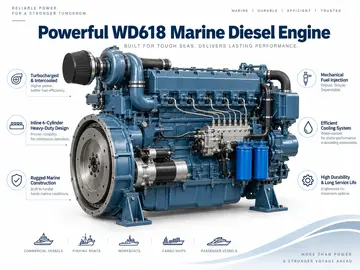
Agree warranty terms in writing before ordering. That means the period or running hours, what is covered, and how claims are evidenced. At MARS, warranty is typically one year or 1,500 running hours, confirmed per product. Keep the test report, serial list and commissioning records, because they are the basis of any claim. Ask whether remote commissioning support and a first-service parts kit are included. Both matter a lot for fleets like our inland cargo fleet customer, which runs Weichai WD618 marine engines.
Ready to specify an engine and gearbox package? Send us your vessel data for a matched quotation.
Frequently asked questions
Is FOB or CIF better when importing engines from China?
FOB suits buyers who have a freight forwarder with competitive rates and want to control shipping. CIF suits buyers who want one price to their port. Under both terms, risk passes to the buyer once the goods are on board in China.
Do I need an EIAPP certificate for a marine diesel engine?
Marine diesel engines above 130 kW installed on ships subject to MARPOL Annex VI generally need an EIAPP certificate. Smaller vessels and domestic trades may follow national rules, so check with your flag state or class society before ordering.
What should a supplier's test report include?
It should include the engine and gearbox serial numbers, test date, rpm, oil pressure, coolant temperature, load steps where tested, and any observations. A matching video that shows the nameplate is strong supporting evidence.
Why does wooden packing need ISPM 15 marking?
Many importing countries require solid wood packaging to be heat treated or fumigated and marked under ISPM 15 to stop pests spreading. Packing without the mark can be held, treated or destroyed at the buyer's cost.
How long does a built-to-order engine take to ship from China?
Production of a built-to-order engine typically takes a few weeks, often around 20 working days. Inspection, packing and ocean transit come on top of that. Classed engines and special specifications can take longer.