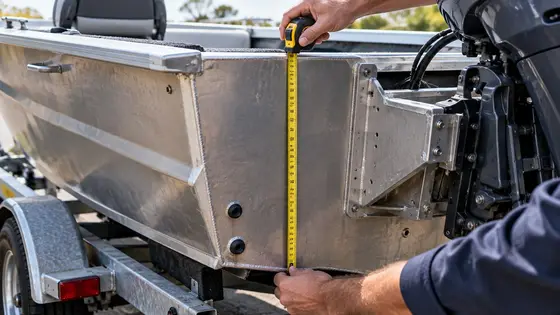
Outboard shaft length is the vertical distance from the top of the motor's transom clamp bracket to the anti-ventilation plate, and it must match the height of your boat's transom. The standard sizes are about 15 inches (short), 20 inches (long), 25 inches (extra long) and 30 inches (extra-extra long); measure your transom from its top edge down to the bottom of the hull at the centerline and choose the shaft that matches that figure.
Key takeaways
- Nominal outboard shaft lengths are 15 in (381 mm), 20 in (508 mm), 25 in (635 mm) and 30 in (762 mm); some manufacturers' actual lengths run up to about 2 in longer than nominal.
- Transom height is measured vertically at the centerline, from the top of the transom to the bottom of the hull or keel line.
- As a starting point, the anti-ventilation plate should sit roughly level with the bottom of the hull, then be fine-tuned up or down.
- A shaft that is too short causes ventilation, loss of grip and possible overheating; a shaft that is too long causes drag, spray and lost speed.
- Small portable motors are commonly offered in 15 in and 20 in shafts; large V6 and V8 outboards are usually 25 in or 30 in.
- Shaft length is usually coded in the model name (for example S, L, X, XL or U), but the coding differs by maker, so confirm it on the data sheet.
What is outboard shaft length?
Outboard shaft length is not the length of the driveshaft itself. It is the distance from the inside top of the transom bracket, where the motor rests on the transom, down to the anti-ventilation plate, the flat horizontal plate just above the propeller. Some makers call this plate the cavitation plate.
The shaft length decides how deep the propeller sits below the hull. Because the boat's transom height is fixed, the motor's shaft length has to match it so that the propeller runs in clean, solid water behind the hull while the gearcase does not drag more than necessary.
Outboard shaft length chart
The table shows the standard sizes, the transom heights they suit and where each is typically used. Treat the transom ranges as typical; check the boat builder's recommendation for the hull.
| Shaft size | Nominal length | Typical transom height | Common codes | Typical boats |
|---|---|---|---|---|
| Short | 15 in / 381 mm | About 15–17 in | S | Dinghies, inflatables, small jon boats and skiffs |
| Long | 20 in / 508 mm | About 20–22 in | L | Most runabouts, aluminum fishing boats, pontoons |
| Extra long | 25 in / 635 mm | About 25 in | X, XL | Larger center consoles, offshore hulls, sailboat auxiliaries |
| Extra-extra long | 30 in / 762 mm | About 30 in | U, XX, XXL | Large offshore boats, high transoms, some catamarans |
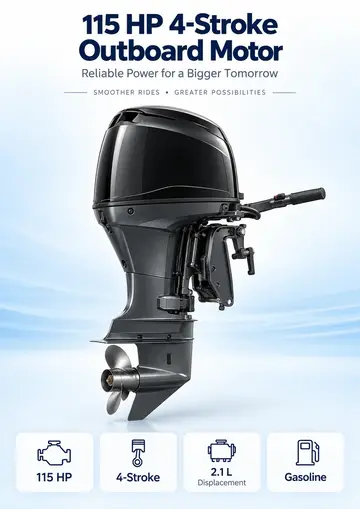
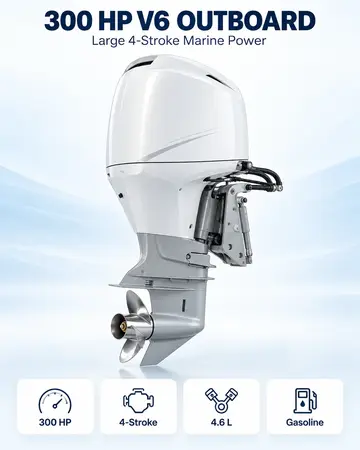
Most mid-range outboards of roughly 40 to 150 hp are sold mainly in 20 in shafts, such as a 115 hp long-shaft four-stroke, where the "L" in the model code indicates the long shaft. High-power outboards, such as a 300 hp XL four-stroke, are typically 25 in or longer.
How do I measure outboard shaft length and transom height?
Measure both the boat and the motor, and compare. You need a tape measure, a straight edge longer than the transom is deep, and ideally a helper.
To measure transom height on the boat:
- Find the centerline of the transom where the motor will mount.
- Measure vertically from the top edge of the transom straight down to the bottom of the hull at the keel.
- If the hull bottom is notched, stepped or has a pronounced V, lay a straight edge along the keel and extend it aft past the transom, then measure to the straight edge.
- Measure vertically, not along a raked transom; most transoms lean aft by several degrees, and measuring along the slope gives a slightly longer figure.
To measure shaft length on an existing outboard:
- Trim the motor fully down so the shaft is vertical.
- Measure from the inside top of the clamp bracket, where it sits on the transom, straight down to the anti-ventilation plate.
- Round to the nearest standard size: 15, 20, 25 or 30 inches.
If your transom measures 15 to 17 inches, choose a short shaft; 20 to 22 inches, a long shaft; around 25 inches, an extra long. When the figure falls between sizes, the boat builder's recommendation and the mounting-height adjustment holes usually settle it.
Short shaft vs long shaft outboard: what is the difference?
The only functional difference is the length of the midsection, which sets how deep the gearcase and propeller sit. A long shaft outboard puts the propeller about 5 inches deeper than a short shaft version of the same motor and weighs slightly more.
A short shaft outboard suits low transoms on dinghies, inflatables, canoes with a transom and small aluminum boats. It keeps the lower unit shallow, which helps in skinny water and on beaches. A long shaft outboard suits the 20-inch transoms that most fiberglass runabouts, many aluminum fishing boats and most pontoon boats are built with.
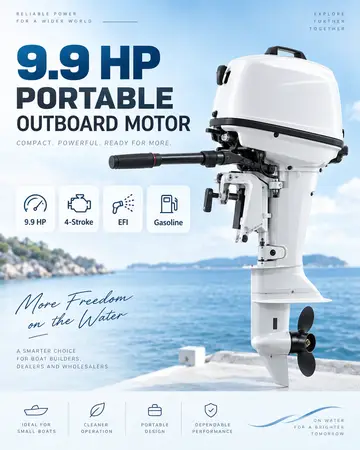
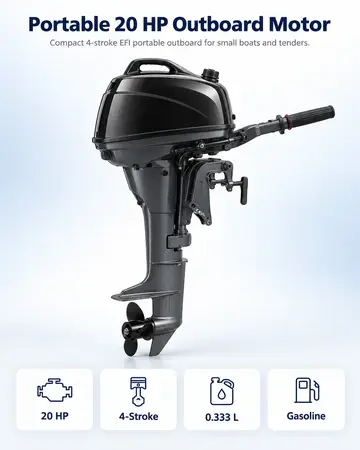
For small motors, both sizes are usually offered. Portable motors from about 2.5 to 20 hp, including the 9.9 hp EFI portable, commonly come in 15 in and 20 in versions. See our guide to small portable and kicker outboards for how to choose among them.
When do you need an extra long shaft outboard?
Choose an extra long (25 in) or extra-extra long (30 in) shaft when the transom is that high, or when the propeller needs extra depth to stay in the water. Typical cases include larger offshore boats with high transoms, catamarans, and sailboats.
Sailboats and displacement hulls that pitch in waves are the classic case for an extra long shaft. When the stern lifts, a short or long shaft propeller can come out of the water and race, so many sailboat auxiliaries use a 25 in shaft on an adjustable bracket. Some makers offer sail-specific models with high-thrust gearing and longer shafts for this reason.
What happens if the shaft length is wrong?
A wrong shaft length costs performance and can damage the motor. The effects depend on which way it is wrong.
Shaft too short (motor too high):
- The propeller draws air from the surface and ventilates, especially in turns and rough water.
- The water intakes on the gearcase can draw air, which can cause overheating.
- The boat struggles to plane and loses grip under load.
Shaft too long (motor too low):
- The gearcase and anti-ventilation plate create extra drag and spray, reducing top speed and fuel economy.
- The lower unit sits deeper and is more likely to strike bottom in shallow water.
- Steering can feel heavier, and the bow may run lower than ideal.
How high should an outboard be mounted on the transom?
As a starting point, the anti-ventilation plate should be roughly level with the bottom of the hull, checked with a straight edge laid along the keel and extended aft with the motor trimmed so the propshaft is parallel to it. From there, height is fine-tuned through the mounting holes in the transom bracket, which are often spaced about 3/4 inch apart.
Raising the motor one hole at a time reduces drag and can add speed on many planing hulls, provided the propeller keeps its grip and water pressure stays normal. Lowering it improves bite in rough water and with heavy loads. A jack plate allows height to be adjusted more precisely and, on some setups, while under way. On workboats and rental boats, a slightly conservative (lower) setting is usually preferred because it is more forgiving of loading and sea state.
What if my transom height does not match a standard shaft?
Small mismatches are normal and are handled by the bracket's mounting holes. Larger mismatches have several fixes:
- Jack plate or setback bracket: raises the motor and moves it aft, useful when the shaft is slightly too long.
- Transom modification: a boatyard can cut down or build up the motor well, which is a structural job for a qualified shop.
- Adjustable outboard bracket: common on sailboats and small displacement boats with high or awkward transoms.
- Change the motor: sometimes the most economical choice if the mismatch is a full size or more.
When ordering for a mixed fleet, list shaft length separately for every hull. A fleet that mixes 90 hp and 9.9 hp motors, like the marina rental outboards project, is exactly where shaft length errors creep in. Many motors on the outboard motors page are offered in more than one shaft length, so when you ask MARS for a quotation, include the transom height of each hull and the shaft code can be confirmed before the order is placed. To check the right size, send your transom measurements.
Frequently asked questions
How long is a short shaft outboard motor?
A short shaft outboard has a nominal shaft length of 15 inches (about 381 mm), measured from the top of the transom bracket to the anti-ventilation plate. It suits transoms of roughly 15 to 17 inches.
How long is a long shaft outboard?
A long shaft outboard is nominally 20 inches (about 508 mm) and suits transoms of roughly 20 to 22 inches. It is the most common size for runabouts, fishing boats and pontoons.
Can I put a long shaft outboard on a short shaft transom?
It will work, but the propeller and gearcase will sit about 5 inches too deep, adding drag and spray and reducing speed. A jack plate can raise it, but the better solution is usually the correct shaft length.
How do I tell the shaft length from the model number?
Many makers include a letter in the model code, such as S for short, L for long and X, XL or U for extra long. The coding differs between manufacturers, so measure the motor or check the data sheet to be sure.
Does shaft length affect horsepower or speed?
Shaft length does not change engine power, but the wrong length reduces usable thrust and speed through ventilation or extra drag. Correct mounting height is one of the cheapest ways to recover lost performance.