Small outboard motors, usually defined as portable tiller motors from about 2 to 20 hp, are the standard power for inflatable dinghies, yacht tenders, jon boats, small aluminum skiffs and sailboat auxiliaries, and as kicker motors for trolling and backup on larger boats. Choose by boat rating and weight first: 2 to 6 hp motors weigh roughly 17 to 28 kg and can be carried by one person, while 9.9 to 20 hp motors weigh roughly 40 to 60 kg and are usually left on the boat.
Key takeaways
- Small outboards fall into four practical classes: 2 to 3.5 hp, 4 to 6 hp, 8 to 9.9 hp and 15 to 20 hp, each with typical boat types and weights.
- Most small outboards are offered in 15 in (short) and 20 in (long) shafts; sailboats and kicker brackets often need the long or an extra-long shaft.
- Many 2 to 6 hp motors have a built-in fuel tank, while 9.9 hp and larger usually run from a separate portable tank.
- Electronic fuel injection, electric start and power tilt are increasingly available from about 9.9 hp upward.
- A kicker motor, usually 6 to 15 hp, is mounted beside the main engine for slow trolling and as a get-home backup.
- Four-stroke portable motors must be stored and carried according to the manual, which usually specifies which side they may lie on to keep oil out of the cylinder.
What counts as a small outboard motor?
In the trade, "small" or "portable" outboards are tiller-steered motors light enough to be lifted on and off a transom, generally from about 2 hp up to 20 hp. Above about 25 to 30 hp, motors are heavier, usually rigged with remote controls and treated as permanently installed.
Small outboard motors sold new in the US and EU today are almost all four-strokes, because of emission rules, though small carbureted two-strokes are still sold in some export markets. Most are single- or twin-cylinder, water-cooled and steered with a tiller handle that also carries the twist-grip throttle. A few of the smallest models are air-cooled, and some 2 to 2.5 hp models have no neutral or reverse gear; the motor is swiveled 360 degrees to go astern.
Which small outboard size fits which boat?
The table lists typical uses and indicative weights. Weights vary by maker, shaft length and starting system, so always check the data sheet and the boat's maximum rating.
| Power class | Typical dry weight | Typical boats | Common features |
|---|---|---|---|
| 2–3.5 hp | About 13–20 kg | Small inflatables, canoes with transom, light tenders | Integral tank, recoil start, some without neutral |
| 4–6 hp | About 21–28 kg | Larger inflatables, small sailboats, 10–12 ft skiffs | Integral tank with external tank option, forward-neutral-reverse |
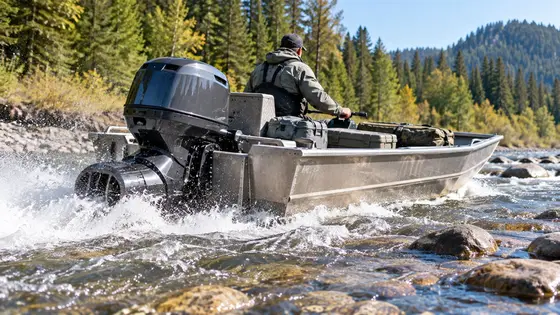
| 8–9.9 hp | About 35–50 kg | Jon boats, 12–14 ft aluminum boats, RIB tenders, kicker use | External tank, optional electric start and EFI |
| 15–20 hp | About 45–60 kg | 14–16 ft aluminum boats, larger RIBs, small workboats | External tank, EFI common, electric start and power tilt options |
A 2.5 hp four-stroke typically weighs about 17 to 20 kg, a 4 to 6 hp about 27 kg, and a 20 hp twin-cylinder four-stroke roughly 50 to 55 kg. Those differences decide whether a motor can realistically be lifted from a dinghy into a yacht's lazarette or carried down a beach.
What is the best small outboard for an inflatable boat or tender?
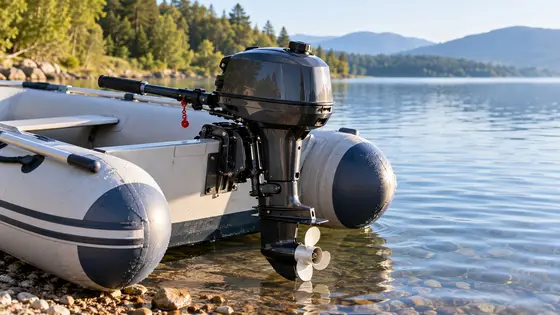
For most inflatable dinghies and yacht tenders, the best choice is the lightest motor that will do the job within the boat's maximum rating. A 2 to 3.5 hp motor pushes a small soft-bottom inflatable at displacement speed; planing an air-floor or RIB tender with two adults usually takes 8 to 15 hp or more, depending on size and load.
Tender use favors a short 15 in shaft, since most inflatable transoms are low, a built-in fuel tank on the smallest motors, and a carrying handle that balances the motor. Because tender motors are often moved between boat and rail mount, a lighter motor is also safer to handle. Check the inflatable's capacity label carefully; it is often lower than buyers expect.
What is a kicker motor and what size do I need?
A kicker motor is a small auxiliary outboard mounted on the transom beside the main engine, usually on its own bracket. It is used for slow trolling, which a large main outboard does poorly, and as a get-home engine if the main motor fails.
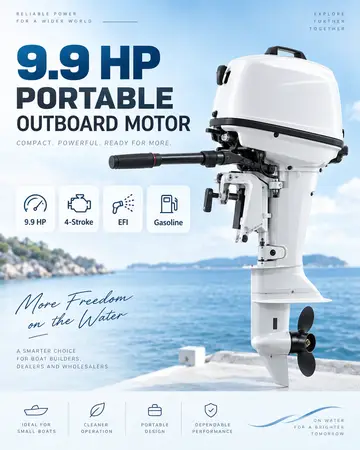
Most kickers are 6 to 15 hp, with 9.9 hp the most common size for 16 to 22 ft fishing boats. A 9.9 hp motor such as the 9.9 hp EFI portable four-stroke offers fine low-speed control and enough thrust to bring a mid-size boat home at low speed. Some lakes restrict motors to 10 hp or less, which also makes 9.9 hp models popular as the main engine on small boats.
Kicker installation points:
- Shaft length: match the kicker bracket height; a long 20 in shaft is common, and some brackets need 25 in.
- Steering: many owners link the kicker to the main engine's steering with a tie bar, or use a remote steering kit.
- Charging: an electric-start kicker with a charging output can keep a battery topped up during long trolling sessions.
- Clearance: check that both motors can tilt fully without contact.
Which small outboard suits a sailboat?
Sailboats and other displacement hulls need thrust, not speed. A 4 to 9.9 hp motor typically pushes a 20 to 26 ft sailboat at or near hull speed, and some makers offer high-thrust sail models with lower gear ratios and larger, finer-pitched propellers for this duty.
Because sailboat sterns pitch in waves, a long or extra-long shaft on an adjustable outboard bracket keeps the propeller in the water. The shaft length choice matters more here than horsepower; see our outboard shaft length guide for how to measure the transom and bracket.
Which features matter on a 10 to 20 hp outboard?
From about 9.9 hp up, small outboards start to look like larger motors. The features worth comparing are:
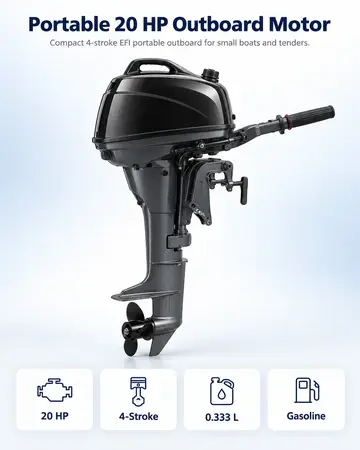
- Fuel system: electronic fuel injection, as on the 20 hp EFI portable, starts more easily, tolerates sitting better than a carburetor and usually uses less fuel.
- Starting: recoil start is simplest; electric start needs a battery but is easier for rental customers and older users.
- Tilt and trim: manual tilt is standard, while power tilt or tilt-and-trim on 15 to 20 hp models helps in shallow launching and on heavier boats.
- Steering and controls: tiller is standard; some 9.9 to 20 hp motors can be rigged for remote steering and throttle. Our guide to tiller vs remote steering explains the trade-offs.
- Fuel tank and connector: confirm the tank capacity and the hose connector type, especially for fleets; see the outboard fuel system guide.
- Licensing and registration: some countries tie boat licensing or registration to engine power, so check national rules before choosing between, for example, 15 and 20 hp.
How do I carry and store a small four-stroke outboard?
A four-stroke portable outboard has an oil sump, so if it is laid on the wrong side, oil can run into the cylinder or air intake and cause hard starting, smoke or damage. Most owner's manuals specify one or two permitted resting positions; follow them every time.
Good practice for transport and storage:
- Run the carburetor dry or close the fuel valve before laying the motor down, if the manual recommends it.
- Carry the motor upright on a stand or bracket wherever possible.
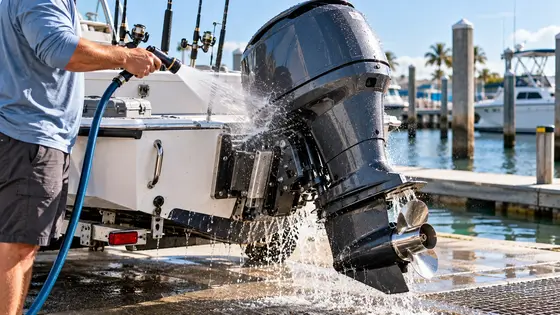
- Flush the cooling system with fresh water after saltwater use.
- Change gear oil, check the impeller and fit fresh spark plugs on the schedule in the manual, typically every 100 hours or once a year.
Are small outboards a good choice for rental and commercial fleets?
Yes, small outboard motors are the backbone of many rental and utility fleets because they are simple, inexpensive to run and easy to swap between boats. Standardizing on one or two models, for example a 9.9 hp for small boats alongside a larger main-engine rating, keeps spare parts and service simple, as on the marina rental outboards project.
For fleets, prioritize EFI for reliable starting, electric start where customers are inexperienced, durable tiller controls and a common fuel connector across all boats. MARS supplies portable outboards for export, packed in export wooden boxes and shipped FOB or CIF Shanghai, with stock items shipping promptly. Ask for a fleet quotation.
Frequently asked questions
What size outboard do I need for a 10 ft inflatable?
Most 10 ft inflatable dinghies are rated somewhere around 5 to 15 hp, depending on floor type and tube size. A 2.5 to 6 hp motor gives displacement speeds, while planing usually needs the upper end of the boat's rating.
How much does a 5 hp outboard weigh?
A 5 to 6 hp four-stroke portable typically weighs about 25 to 28 kg (roughly 55 to 62 lb), depending on shaft length and model. Check the data sheet for the exact figure.
Is a 9.9 hp or 15 hp outboard better for a 14 ft boat?
A 15 hp gives noticeably better planing performance on most 14 ft aluminum boats, while a 9.9 hp is lighter and suits waters with 10 hp limits. Stay within the boat's capacity plate rating.
Can a small outboard be used as a backup engine?
Yes. A 6 to 15 hp kicker mounted beside the main engine can bring most small and mid-size boats home at low speed if the main engine fails, provided it has its own fuel supply and is maintained.
Do small outboards have reverse gear?
Most small outboards from about 4 hp upward have forward, neutral and reverse. Some of the smallest 2 to 2.5 hp models have forward only, and the motor is turned 180 degrees or more to move astern.