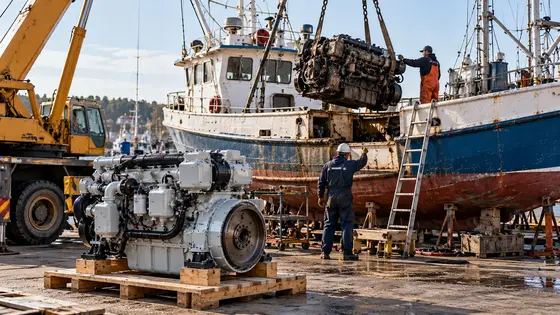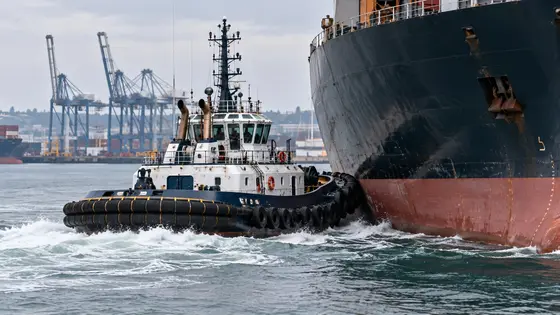
A tugboat engine is a heavy-duty marine diesel rated for continuous full load, usually installed in pairs and matched to large, slow-turning propellers or azimuth thrusters so the tug can produce maximum thrust at near-zero speed. Harbor tugs typically carry two engines totaling a few thousand horsepower and deliver roughly 40–80 tonnes of bollard pull, while ocean-going and anchor-handling tugs can exceed 20,000 hp.
Key takeaways
- A tugboat (tug) is a vessel built to push, pull or escort other vessels or barges; its key performance figure is bollard pull, not speed.
- The main tug types are conventional twin-screw, azimuth stern drive (ASD), tractor, rotor, escort, ocean-going and anchor-handling tugs, plus inland pushboats and articulated tug-barge units.
- As a rough rule of thumb, a tug delivers about 1 to 1.3 tonnes of bollard pull per 100 brake horsepower, with nozzles and controllable-pitch propellers at the upper end.
- Tug engines run long periods at or near full load, so they need a continuous or heavy-duty rating, not a pleasure or intermittent rating.
- Most harbor tugs use twin high-speed or medium-speed diesels for redundancy and maneuvering.
- Since its delivery in 2020, the anchor-handling tug Island Victory has been widely reported as the strongest tug, with about 477 tonnes of bollard pull.
What is a tugboat and what does it do?
A tugboat is a small, powerful vessel that maneuvers other vessels by pushing or towing them. In nautical terms, to "tug" or tow is to move another vessel with a line or by direct pushing, and the tug provides the thrust and steering the assisted vessel lacks at low speed.
Typical tugboat jobs include:
- Ship assist — berthing and unberthing large ships in harbor.
- Escort — steering and braking tankers and gas carriers through confined channels using hydrodynamic forces.
- Towing — pulling barges, dead ships, rigs or structures along the coast or across oceans.
- Pushing — driving barges ahead, especially on rivers and in tug and barge combinations.
- Offshore support — anchor handling, rig moves and emergency towing.
- Salvage and firefighting — many harbor and ocean tugs carry fire monitors and salvage gear.
What are the main types of tugboat?
Tugs are classified by where they work and by their propulsion arrangement. Propulsion type decides how the tug maneuvers, which in turn decides how the engines and drivetrain are configured.
| Tug type | Propulsion | Typical work | Notes |
|---|---|---|---|
| Conventional tug | Twin shafts, fixed or CP props, often in nozzles, rudders | Towing, coastal work, older harbor fleets | Simple, robust; less agile than azimuth tugs |
| ASD (azimuth stern drive) | Two azimuth thrusters at the stern | Modern harbor ship assist | Thrust in any direction; most common new harbor tug |
| Tractor tug | Azimuth or cycloidal propellers forward of midships | Ship assist, escort | Very maneuverable, works well over the bow or stern |
| Rotor tug | Three azimuth thrusters | Ship assist, escort | High redundancy and agility |
| Escort tug | ASD or tractor with a deep skeg | Tanker and LNG escort | Rated by steering and braking force as well as bollard pull |
| Ocean-going / salvage tug | Twin shafts or azimuths, large engines | Long-distance towing, salvage | Long range, towing winch, high bollard pull |
| Anchor-handling tug supply (AHTS) | Twin shafts with CP props, thrusters | Offshore rig moves | Some of the most powerful tugs afloat |
| Pushboat / towboat | Multiple shafts, flat hull | River barge tows | Push ahead rather than tow astern |
| Articulated tug barge (ATB) | Conventional or azimuth | Coastal cargo and fuel transport | Tug locks into a notch in the barge stern |
Small tugboats for marinas, workboat fleets and canals may be only 10–15 m long with one or two engines in the low hundreds of kilowatts. At the other end, the biggest tugboats in the world are anchor-handling vessels with bollard pull above 300 tonnes.
How are tugboats so strong?
Tugboats are strong because they convert engine power into thrust at very low speed, using big propellers turning slowly inside nozzles or azimuth units. Their hull, engines and drivetrain are designed for pulling force rather than speed.
Several design features work together:
- High reduction ratios — engines turning 1,000–1,900 rpm drive propellers at a few hundred rpm or less, multiplying torque.
- Large propellers — a large-diameter propeller moves more water at lower velocity, which produces more thrust per kW at low speed.
- Kort nozzles — a duct around the propeller increases thrust at low speed, which is why most tugs use them.
- Heavy-duty engines — continuous-rated diesels can hold full power for hours without exceeding thermal limits.
- Strong hull and towing gear — heavy fendering, towing winches, staples and a low, wide hull for stability under line tension.
How much horsepower does a tug boat have?
Tugboat horsepower ranges from a few hundred horsepower on small harbor and workboat tugs to more than 20,000 hp on the largest anchor-handling tugs. Most modern harbor tugs carry two engines totaling roughly 3,000–7,000 hp.
| Tug class | Typical installed power (indicative) | Typical bollard pull (indicative) |
|---|---|---|
| Small harbor, marina or workboat tug | 300–1,500 hp | 5–20 t |
| Standard harbor tug | 2,000–5,000 hp | 25–60 t |
| Large ASD or escort harbor tug | 5,000–8,000 hp | 60–100 t |
| Ocean-going tug | 5,000–15,000 hp | 70–200 t |
| Large anchor-handling tug | 15,000–30,000+ hp | 200–477 t |
| River pushboat | ~1,000–10,000+ hp | Rated by push capacity |
These figures are broad ranges from published vessel data and vary by design. The only reliable bollard pull number for a specific tug is the one measured in a certified bollard pull trial, which classification societies witness and record.
A commonly used estimating formula multiplies brake horsepower by about 0.9 and a propulsion factor, then divides by 100, giving roughly 1 tonne per 100 bhp for open fixed-pitch propellers and up to about 1.26 tonnes per 100 bhp for controllable-pitch propellers in nozzles. Treat it as a rough check, not a design value.
What kind of tugboat engine do tugs use?
Tugboats use heavy-duty marine diesel engines with continuous or heavy-duty ratings, typically one per shaft or thruster. High-speed engines (around 1,600–2,100 rpm) dominate small and mid-size harbor tugs, while large ocean and anchor-handling tugs often use medium-speed engines.
Choosing a tugboat engine
Selecting a tugboat engine is a duty-cycle decision. A harbor tug may idle for long periods and then run at full power for several minutes during a ship assist, while an ocean tug may hold high load for days.
- Rating — choose a continuous or heavy-duty rating that permits unrestricted full-load operation. Ratings follow the manufacturer's definitions, usually referenced to ISO 3046 conditions.
- Power per shaft — split total power across two engines for redundancy; losing one engine still leaves steerage and partial pull.
- Rated speed and torque — lower-speed, larger-displacement engines generally tolerate sustained load better.
- Gearbox or thruster input — match the engine to the azimuth thruster input speed or to a heavy-duty reversing reduction gearbox such as the HCD800, or larger units like the GWC series for higher power.
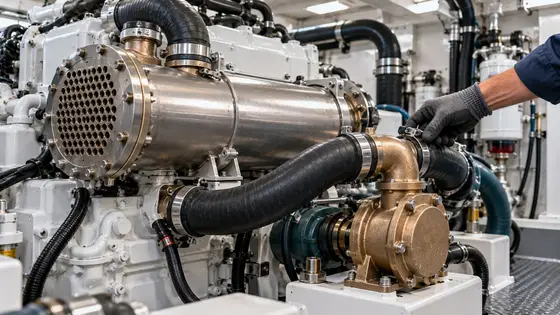
- Cooling — keel cooling or box coolers suit harbors with silt and debris; see our heat exchanger vs keel cooling guide.
- Class and emissions — tugs working in classed service or emission control areas need the appropriate class approval and IMO NOx tier compliance.
Typical engine classes for tugs
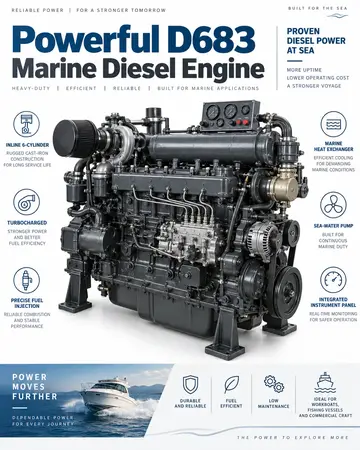
- Small tugs and workboats — inline six-cylinder engines around 200–400 hp, such as the D683 at 320 hp.
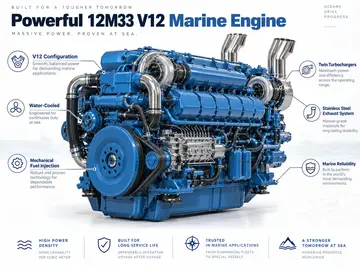
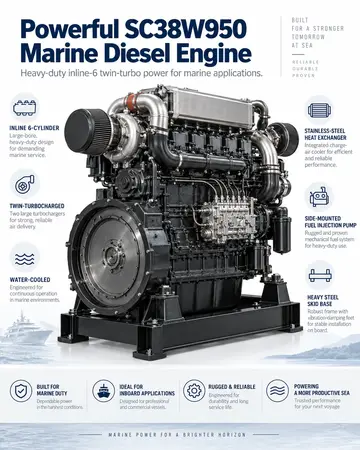
- Harbor tugs — V12 or large inline engines around 700–1,500 hp per side, such as the 12M33C1000-15 V12 at 1,000 hp or the SC38W950 at 950 hp.
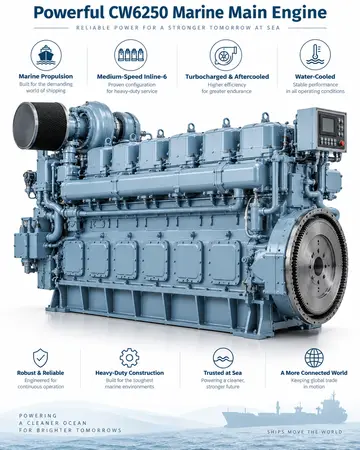
- Larger tugs — 1,000 kW-plus main engines such as the CW6250ZLC-1N, usually with heavy-duty reduction gears.
A twin-engine configuration is standard practice. The harbor tug twin-engine project is an example of a pair of V12 main engines in this class.
What should you send when sourcing tug engines?
Send the tug's type, length, propulsion arrangement, target bollard pull and the existing engines, gearboxes or thrusters, plus the class society if the tug is classed. Include propeller or thruster data and engine-room dimensions.
MARS matches engines and gearboxes for tug repowers and newbuilds, runs a machinery test with a written report and video before dispatch, and ships FOB or CIF Shanghai. Built-to-order engines typically take around 20 working days. Request a matched tug propulsion quote.
Frequently asked questions
What is the meaning of tugboat?
A tugboat, or tug, is a vessel designed to move other vessels or barges by towing or pushing them. Its defining feature is high pulling power for its size.
What is bollard pull?
Bollard pull is the static pulling force a tug can exert on a line attached to a fixed point at zero speed, usually stated in tonnes. It is measured in a witnessed bollard pull trial.
What is the difference between a tractor tug and an ASD tug?
A tractor tug has its propulsion units forward of midships and tows mainly over the stern, while an ASD tug has two azimuth thrusters at the stern and usually works over the bow. Both can direct thrust in any direction.
What is an articulated tug barge?
An articulated tug barge (ATB) is a tug that fits into a notch in the stern of a barge and connects with a pinned joint, letting the pair operate almost like a single ship while still allowing the tug to disconnect.
What is the biggest tugboat in the world?
Island Victory, an anchor-handling tug supply vessel delivered in 2020, has been widely reported as the strongest tug with about 477 tonnes of bollard pull.
Do tugboats use diesel engines?
Almost all do. Heavy-duty marine diesels are standard, with some newer tugs using hybrid diesel-electric, LNG or battery-electric propulsion.