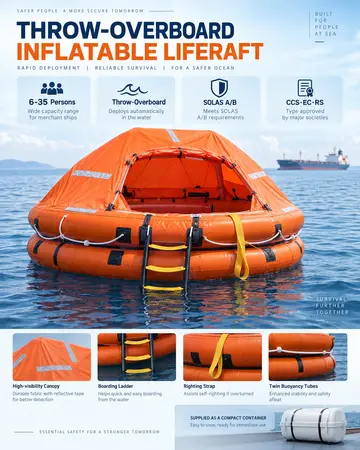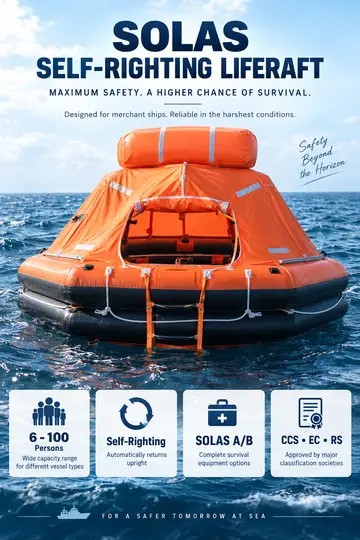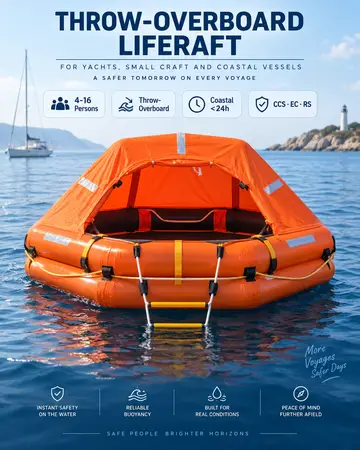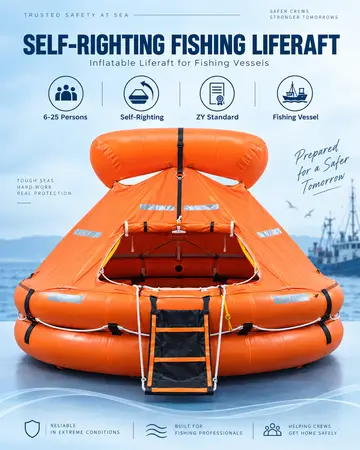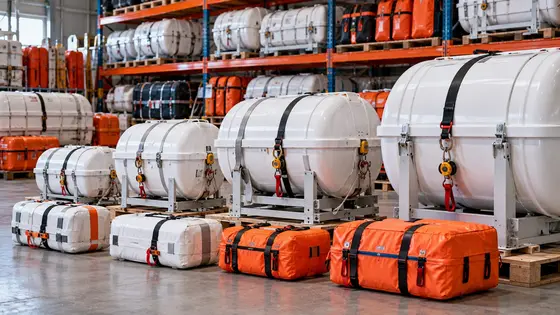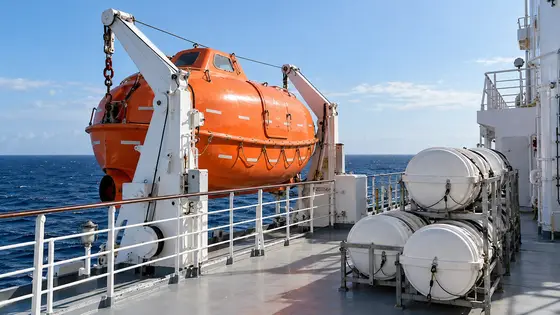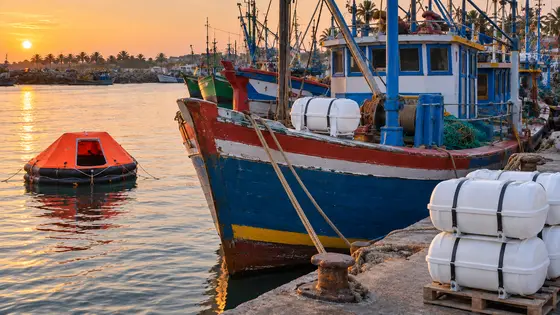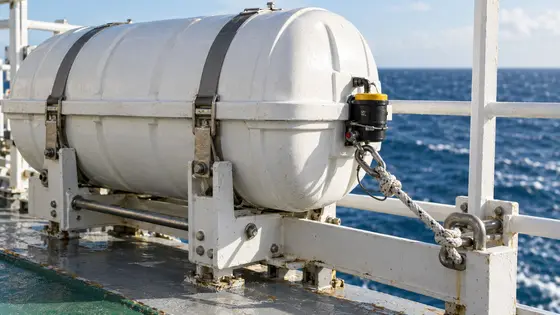
A hydrostatic release unit (HRU) is a pressure-activated device that frees a liferaft or float-free EPIRB from its cradle when a ship sinks before the crew can launch it. Under paragraph 4.1.6 of the IMO LSA Code it must release automatically at a depth of no more than 4 m, after which the buoyant canister rises, pulls out the painter, inflates the raft and a weak link breaking at 2.2 ± 0.4 kN parts so the vessel cannot drag the raft down.
Key takeaways
- An HRU is the most common way to meet the SOLAS chapter III requirement that liferafts float free and, if inflatable, inflate automatically when the ship sinks.
- The LSA Code requires automatic release at a depth of not more than 4 m; most units are designed to activate somewhere between about 1.5 m and 4 m.
- The weak link in the float-free arrangement must break under a strain of 2.2 ± 0.4 kN, which is roughly 1.8 to 2.6 kN.
- HRUs are either disposable (replaced at the marked expiry date, commonly about two years) or serviceable (serviced at intervals not exceeding 12 months).
- Most HRU failures found in port state and flag inspections come from incorrect fitting: wrong weak link, painter tied to the wrong point, over-tight straps or extra lashings.
- An HRU never replaces manual release; every raft must still be launchable by hand in seconds without tools.
What is an HRU and why do ships carry one?
An HRU is the automatic part of a liferaft's float-free arrangement. It answers a simple problem: if a ship capsizes or founders quickly, there may be no time to throw rafts overboard, so the raft must release itself and inflate on the surface.
SOLAS regulation III/13.4 requires liferafts to be stowed with the painter permanently attached to the ship and with a float-free arrangement complying with LSA Code paragraph 4.1.6. In practice almost every throw-overboard raft on a SOLAS ship sits in a cradle held by straps that pass through an HRU, and many fishing vessels, workboats and yachts follow suit. The same principle is used for Category 1 EPIRBs, where the HRU frees the beacon so it floats up and starts transmitting.
If you are still choosing the raft itself, our guide to SOLAS inflatable liferaft types explains throw-overboard, davit-launched and self-righting designs.
How does a hydrostatic release unit work?
An HRU works by sensing water pressure. When the unit reaches its activation depth, the pressure on a sealed chamber triggers a spring-loaded blade that cuts the line holding the raft's securing straps.
The sequence during a sinking is:
- Submersion. The ship goes down with the raft still in its cradle. Water enters the HRU's pressure chamber through its housing.
- Activation. At a depth of no more than 4 m, pressure on a diaphragm releases a spring-loaded knife, which cuts the rope or link that holds the lashing straps.
- Float-up. The straps fall away and the canister, which is buoyant by design, rises towards the surface.
- Inflation. As the canister rises and the ship keeps sinking, the painter pays out. When it reaches the end of its length and tightens, it pulls the operating head on the gas cylinder and the raft inflates.
- Separation. The pull of the inflated raft against the sinking ship breaks the weak link, leaving the raft floating free with the painter still attached to the raft for survivors to use.
The weak link is the critical detail. It must be strong enough to fire the inflation system but weak enough to break before the ship drags the inflated raft under. That is why the LSA Code fixes its breaking strain at 2.2 ± 0.4 kN for SOLAS arrangements.
What does the LSA Code require of an HRU?
The LSA Code sets performance and marking requirements that every approved HRU must meet. Type approval is issued by the flag administration or on its behalf, often under schemes such as the EU Marine Equipment Directive or USCG approval.
| Requirement | What it means in practice |
|---|---|
| Automatic release at a depth of not more than 4 m | Most units activate between about 1.5 m and 4 m; check the data sheet |
| Weak link breaking strain of 2.2 ± 0.4 kN | Use the weak link supplied with the HRU, never a piece of small line |
| Drains to stop water collecting in the pressure chamber | Mount the unit the right way up so it drains |
| Must not release when seas wash over it | Green water on deck should not trigger the unit |
| Compatible, corrosion-resistant materials | Avoid contact with dissimilar metals such as copper fittings |
| Permanent marking of type and serial number | Record these in the raft register |
| Date of manufacture or, for disposable units, expiry date | Inspect the date at every safety round |
| Parts connected to the painter as strong as the painter | Fittings, shackles and slips must not be the weakest point other than the weak link |
Release depth does not change with raft size, but the load on the weak link does, which is why some manufacturers offer lower-rated versions for small, low-buoyancy rafts.
What types of hydrostatic release are available?
There are two main types: disposable units with a fixed service life and serviceable units that go ashore for annual overhaul. Both perform the same job.
- Disposable (maintenance-free) HRUs are the most common choice today. They carry an expiry date, typically around two years from installation, and are simply replaced.
- Serviceable HRUs are opened, tested and recertified at an approved station at intervals not exceeding 12 months, usually alongside the raft.
- EPIRB HRUs use the same pressure principle but have no weak link, because the beacon floats completely free.
- Multi-raft HRUs exist for some stowage designs, but a standard HRU is approved for one raft only.
Service intervals, extensions and replacement planning are covered in detail in our liferaft servicing and HRU replacement guide, so they are not repeated here.
How do I fit a liferaft HRU correctly?
Correct fitting matters more than the choice of unit. Safety alerts from the Australian Maritime Safety Authority have reported over 100 deficiencies in a single year for faulty HRU arrangements, and UK guidance in MGN 343 lists the same recurring faults.
A sound installation follows these steps, always in line with the raft and HRU manufacturers' instructions:
- Check compatibility. Confirm the HRU is approved for the raft type, capacity and stowage height, and for one raft per unit unless designed otherwise.
- Attach the straps through a quick-release slip. Use a senhouse slip or similar so the crew can free the raft by hand. Never use rope lashings or bottle screws.
- Tension the straps correctly. They should be snug, not over-tight. Over-tensioning, and too little load, can both stop the unit from releasing.
- Connect the painter to the weak link. The painter goes to the weak link, and the weak link to the ship. Do not join several painters to one weak link.
- Remove transport lashings. Shipping bands and extra ties must come off after installation.
- Check the float-up path. The canister needs a clear route upward with no overhangs, rails or cables that could trap it.
- Record it. Log the HRU type, serial number and expiry date against the raft serial number.
For manual launching, the drill is different: the painter must be made fast to a strong point on the ship before the raft goes over the side, not left only on the weak link.
What are the most common HRU mistakes?
Most failures are installation errors rather than faulty units. The faults below are the ones inspectors find again and again:
- Painter tied directly to the ship or cradle instead of to the weak link, so the raft inflates but cannot break free.
- An improvised weak link made from small-diameter line, with an unknown breaking strength.
- Two rafts secured by one HRU that is not approved for it; trials have shown such arrangements may not release at 4 m.
- Straps cranked tight with a bottle screw, or extra lashings added "to be safe."
- Rafts stowed under overhangs or deck structure, so the canister cannot float clear.
- Using a small-raft HRU on a large raft, where a low-rated weak link may break before the raft inflates.
Does every liferaft need a hydrostatic release?
Not always. Some arrangements are exempt or use a different release method.
On cargo ships where the nearest survival craft is more than 100 m from the stem or stern, SOLAS requires an extra liferaft forward or aft, and this raft may be secured for quick manual release instead of float-free release. Small vessels working in shallow or sheltered waters may be allowed by their administration to stow rafts without an HRU, although a correctly rated weak link is still expected. In water shallower than about 4 m, an HRU may never activate, so crews on such vessels should rely on manual launching and know where the firing line is. Davit-launched and evacuation-system rafts follow their own manufacturer and flag requirements.
Frequently asked questions
What is an HRU on a ship?
An HRU, or hydrostatic release unit, is a device that automatically frees a liferaft or EPIRB from its mounting when the ship sinks. It works on water pressure and must activate at a depth of no more than 4 m under the LSA Code.
What depth does a hydrostatic release activate at?
The LSA Code requires release at a depth of not more than 4 m. Most approved units are designed to activate between about 1.5 m and 4 m, but the exact range is on the manufacturer's data sheet.
What is the weak link on a liferaft HRU?
The weak link is the part of the float-free arrangement that connects the painter to the ship and breaks once the raft has inflated. For SOLAS arrangements it must break under a strain of 2.2 ± 0.4 kN.
How often does a hydrostatic release unit need replacing?
A disposable HRU must be replaced when its marked expiry date passes, commonly about two years after installation. Serviceable units are serviced at intervals not exceeding 12 months at an approved station.
Can one HRU be used for two liferafts?
Only if the unit is specifically designed and approved for multiple rafts. Standard HRUs are tested with a single raft, and overloading one can prevent release.
Can the crew release a raft fitted with an HRU by hand?
Yes, and they must be able to. The straps are fitted with a quick-release slip so the raft can be freed and thrown overboard in seconds, with the painter made fast to a strong point first.
MARS supplies throw-overboard liferafts and self-righting SOLAS rafts with matching HRUs and cradles, and on a coastal fishing fleet project each raft went out with a simple fitting and launching card. For replacement HRUs or complete raft packages, send us your vessel list and we will confirm compatible units.