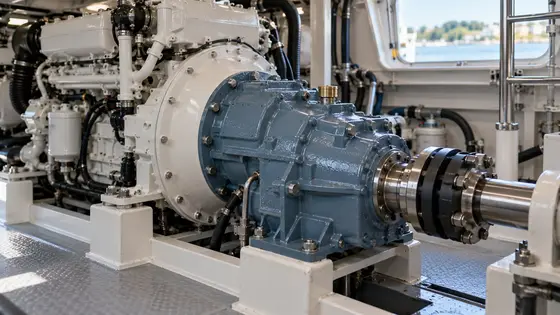
A marine gearbox sits between the engine and the propeller shaft and does three jobs: it reduces engine rpm to an efficient propeller speed, it lets the operator select ahead, neutral and astern, and it carries propeller thrust through its output thrust bearing. The main types are reversing reduction gearboxes (in-line, offset or drop-center), down-angle gearboxes, V-drive gearboxes and large non-reversing reduction gears for slow-speed and controllable-pitch installations.
Key takeaways
- Almost every inboard diesel boat needs a marine gearbox because engines run at 1,500–3,000 rpm while most displacement propellers work best at a few hundred rpm.
- A reversing reduction gearbox combines a reduction gear set with ahead and astern clutches; in commercial sizes the clutches are usually hydraulically actuated wet multi-plate packs.
- Output layout (coaxial, offset, down-angle or V-drive) is chosen to suit the shaft line and engine room, not just the ratio.
- Marine gearbox capacity is commonly expressed as power per rpm (kW/rpm or hp/rpm) for a given duty, so the same box carries more power at higher input speed.
- Slipping engagement, rising oil temperature, new noise and metal particles in the oil are the classic early signs of marine transmission problems.
- Repair usually makes sense for clutch packs, seals and bearings; when the housing, gear teeth or shafts are damaged, replacement is often faster and cheaper.
What does a marine gearbox actually do?
A marine gearbox converts high-speed, low-torque engine output into the lower speed and higher torque a propeller needs, and it isolates the engine from the shaft when in neutral. Without one, a typical high-speed diesel would spin a propeller far too fast for good efficiency.
Its three core functions are:
- Reduction — a ratio such as 2:1, 3:1 or 5:1 divides engine rpm to set propeller speed. Larger, slower propellers generally deliver more thrust per kW, which is why workboats and tugs use high ratios.
- Reversing — two clutches, one ahead and one astern, select direction so the engine itself always turns the same way.
- Thrust absorption — the propeller pushes the boat through the shaft, and that thrust is taken by a bearing in the gearbox output rather than by the engine crankshaft.
Ratio selection is covered in detail in our guide to gearbox reduction ratio and propeller matching.
What are the main types of marine gearbox?
Marine gearboxes are classified by function (reduction only or reversing reduction), by clutch type (mechanical or hydraulic) and by output geometry (coaxial, offset, down-angle or V-drive). The table summarizes the types buyers meet most often.
| Gearbox type | Output layout | Clutch | Typical use |
|---|---|---|---|
| Reversing reduction, offset | Output shaft parallel to and below the input | Hydraulic wet multi-plate | Fishing boats, workboats, tugs, ferries |
| Reversing reduction, coaxial (in-line) | Output on the same centerline as the crankshaft | Hydraulic or mechanical | Boats where a high shaft line suits the hull |
| Down-angle | Output angled downward a few degrees | Hydraulic | Planing boats and yachts with steep shaft angles |
| V-drive | Output turns back under the engine | Hydraulic | Yachts, ski boats, short engine rooms aft |
| Small mechanical gearbox | Usually coaxial or slight offset | Mechanical cone or disc | Small fishing and harbor boats, low power |
| Large reduction gear (non-reversing or reversing) | Offset, often with PTO | Hydraulic, sometimes with CPP propeller | Medium-speed main engines, large tugs and ships |
Reversing reduction gearbox
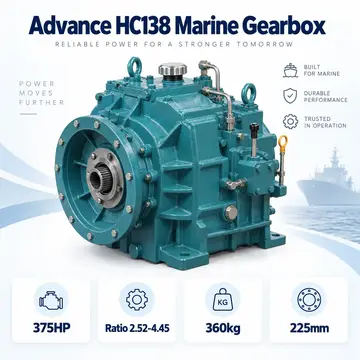
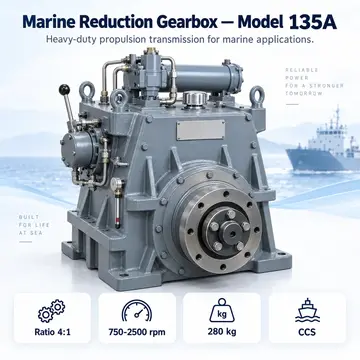
This is the workhorse of commercial craft. Most units use a parallel-shaft layout with a vertical offset between input and output, which lowers the shaft line and lets the engine sit higher above the bilge. Hydraulic reversing reduction boxes such as the HC138 are common on fishing and harbor vessels, and ratio-specific versions like the 135A at 4:1 are selected to put the propeller near its design speed.
Down-angle gearbox
A down-angle box tilts the output flange downward, commonly by around 7 to 10 degrees depending on the model, so the engine can be installed level or nearly level while the shaft runs at the angle the hull requires. This saves engine-room height and keeps the engine's oil sump and fuel system working at the angle the engine maker intended.
V-drive gearbox
A boat V-drive gearbox lets the engine be mounted backward, with its flywheel facing forward, and turns the drive back aft under the engine to the propeller shaft. The result is an engine placed far aft, freeing cabin or cockpit space. V-drive transmissions add complexity and some cost, and service access can be tighter, so they are mainly used on yachts and inboard ski boats rather than workboats.
Large reduction gears and PTO units
On larger vessels, a main reduction gear may be non-reversing when the vessel uses a controllable-pitch propeller, because astern thrust comes from changing blade pitch instead of reversing the shaft. Heavy-duty gearboxes in this class, such as the GWC series, often offer power take-off (PTO) for pumps, winches or a shaft generator.
Mechanical vs hydraulic marine clutch: which is better?
Hydraulic clutches suit almost all commercial duty because they engage smoothly, tolerate frequent shifting and can be controlled remotely. Mechanical clutches are simpler and cheaper, and they still make sense on small, low-power boats.
- Mechanical marine clutch — the shift lever directly engages a cone or disc clutch. Small, low-power units such as the 16A are typically of this type; confirm on the data sheet. There is no hydraulic pump or oil cooler to maintain, but shift effort rises with power.
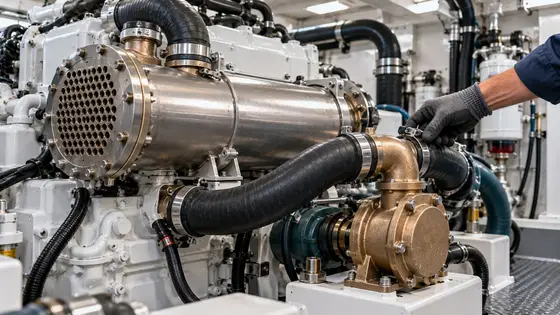
- Hydraulic clutch — an internal pump supplies oil pressure that clamps wet friction plates. Engagement is consistent and supports single-lever or electronic controls. The gearbox oil usually needs a cooler, often plumbed into the engine's sea-water circuit.
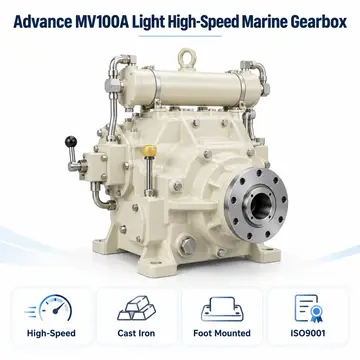
For high-speed craft, light gearboxes such as the MV100A prioritize low weight and compact size, while workboat boxes prioritize continuous-duty capacity and robust thrust bearings.
How do I size a marine reduction gearbox?
Size a marine reduction gearbox by checking its rated capacity at your engine's rated speed and your duty, then confirming the ratio, input housing and output flange fit. Gearbox makers usually publish capacity as kW or hp per 1 rpm of input speed, separately for light, medium and continuous duty.
- Take the engine's maximum power and rated rpm from its data sheet, using the duty rating the vessel will actually run.
- Divide power by rpm and compare against the gearbox capacity figure for that duty; the gearbox figure must be equal or higher.
- Check maximum input speed and torque limits.
- Confirm the SAE bell housing and drive plate match the engine flywheel and flywheel housing.
- Confirm the output flange and shaft coupling, and that the thrust bearing rating covers the propeller thrust.
- Check whether class approval (for example from a classification society) is needed for the vessel.
As an illustration, an engine producing 240 kW at 2,200 rpm needs a gearbox rated at least about 0.11 kW/rpm on the relevant duty. Always use the manufacturer's capacity chart rather than a rule of thumb for the final choice.
What are common marine transmission problems, and should you repair or replace?
Most marine gearbox failures start with oil problems, cooling problems or misalignment, and they usually give warning before total failure. Catching them early is the difference between a clutch-pack repair and a new gearbox.
Failure symptoms to watch for
- Slipping or delayed engagement — rpm rises without matching boat speed, or engagement takes several seconds. Often low oil pressure, worn clutch plates or a failing pump.
- High oil temperature — a blocked or scaled oil cooler, wrong oil grade or slipping clutches.
- New whine, rumble or knocking — worn bearings, damaged gear teeth or a failing damper plate between engine and gearbox.
- Metal particles or a burnt smell in the oil — internal wear that needs investigation before the next trip.
- Vibration that changes with shaft speed — shaft misalignment, a bent shaft or a damaged propeller loading the output bearing.
- Oil leaks or milky oil — failed seals, or water entering through a leaking oil cooler.
- Will not go into gear — shift linkage, control valve or hydraulic faults.
Regular oil changes with the specified oil, correct level checks and verified engine-to-shaft alignment prevent most of these.
Repair vs replace
Boat gearbox repairs make sense when the housing and gear set are sound and the fault is in wear parts. Replacement is usually the better path when damage is structural or the unit is obsolete.
| Situation | Usually repair | Usually replace |
|---|---|---|
| Worn clutch plates, seals, bearings | Yes | — |
| Damaged gear teeth or shafts | Sometimes, if parts are available | Often |
| Cracked housing | — | Yes |
| Parts obsolete or long lead time | — | Yes |
| Repower to a different engine | — | Yes, if capacity or housing no longer fits |
| Repair quote above roughly half of a new unit | — | Usually |
Many marine transmission rebuilders will strip and quote, but factor in downtime too. For a commercial vessel, a new gearbox that ships from stock can cost less overall than weeks off charter.
How do I choose a marine gearbox supplier?
Ask for the capacity chart, ratio options, bell housing and flange details and lead time before price. A supplier that matches gearbox and engine as one package reduces the risk of a capacity or fit mismatch.
MARS supplies marine gearboxes from stock and built to order, and can run-test the engine and gearbox together before dispatch with a written report and video. The twin-engine harbor tug project shows the kind of heavy-duty propulsion installation where gearbox capacity matters most. To get a matched gearbox recommendation, send your engine model, rpm and propeller data.
Frequently asked questions
What is the difference between a marine transmission and a marine gearbox?
They are the same thing in most usage. "Marine transmission" is more common in the US recreational market, while "marine gearbox" or "marine gear unit" is common in commercial and international use.
What is a V-drive gearbox on a boat?
A V-drive gearbox turns the power flow back under the engine so the engine can be mounted backward, far aft in the hull. It is mainly used on yachts and inboard ski boats to free up interior space.
Can I use an industrial gear reducer in a boat?
Generally no. Industrial gear reducers lack the reversing clutches, marine thrust bearing, corrosion protection and marine duty ratings that a marine reduction gearbox provides.
How often should marine gearbox oil be changed?
Follow the manufacturer's manual, which typically sets an interval in running hours plus a first change after break-in. Commercial vessels running long hours change it more often than pleasure boats.
Why does my boat gearbox overheat?
The most common causes are a blocked or scaled oil cooler, low oil level, the wrong oil, or slipping clutch plates. Check the cooler and the sea-water flow first.
What reduction ratio do I need?
The ratio depends on engine rated rpm, propeller size and vessel type; workboats and tugs typically use higher ratios than fast planing craft. A propeller calculation or the existing installation's data is the best starting point.