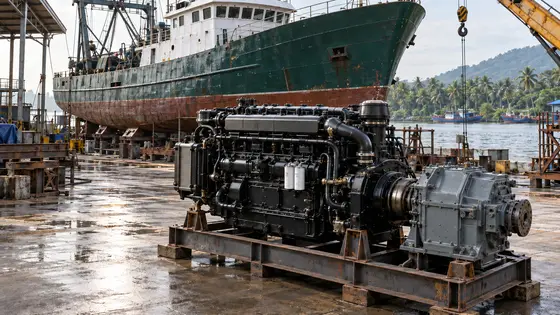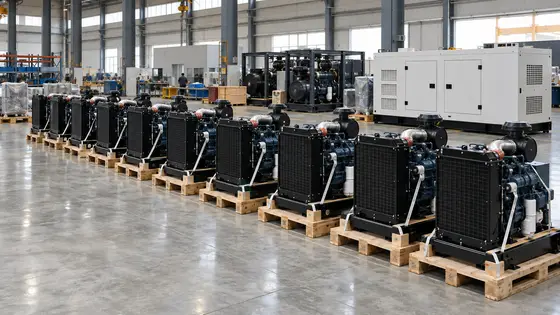
A marine gearbox reduction ratio is the number of engine revolutions per propeller revolution: a 4:1 gearbox behind an engine at 2200 rpm turns the propeller at 550 rpm. To match a gearbox, choose the ratio that puts the propeller at its design speed at the engine's rated rpm, then confirm that the gearbox's power capacity at that input speed, its thrust rating and its bell housing all suit the engine and vessel.
Key takeaways
- Propeller shaft speed equals engine rated rpm divided by the reduction ratio.
- Higher ratios turn a larger, slower propeller, which usually gives more thrust at low boat speed; lower ratios suit smaller propellers on faster hulls.
- Gearbox capacity is limited mainly by torque, so data sheets often state it as power per rpm (kW per r/min) or as maximum power at a stated input speed.
- Engine torque in N·m equals 9550 × power in kW ÷ rpm, and output torque rises roughly in proportion to the ratio.
- The gearbox thrust bearing carries propeller thrust, so its rated thrust must suit the propeller and vessel duty.
- Bell housing, input coupling and output flange must match the engine flywheel housing and the propeller shaft coupling.
What does a marine gearbox reduction ratio actually do?
Diesel engines develop their power at speeds far higher than an efficient propeller wants to turn. A reduction gearbox trades speed for torque: it lowers shaft rpm by the ratio and, apart from small gear and bearing losses, multiplies torque by the same factor. A marine gearbox also provides ahead and astern drive through its clutches, and contains the thrust bearing that transfers propeller thrust into the hull.
A larger, slower propeller is generally more efficient for heavily loaded, slow vessels such as trawlers, tugs and barges, because it accelerates a larger mass of water by a smaller amount. That is why these boats often use ratios of 4:1 or more, while lighter, faster hulls run lower ratios with smaller propellers.
How do I calculate propeller shaft speed?
Divide the engine's rated rpm by the gearbox ratio. The table uses real engine and gearbox combinations to show how ratio changes shaft speed.
| Engine and rated speed | Gearbox and ratio | Propeller shaft speed at rated rpm | Typical fit |
|---|---|---|---|
| Cummins-type 6CTA8.3-M205, 2328 rpm | Advance HC300, 2.04:1 | about 1141 rpm | Faster displacement or semi-planing hulls |
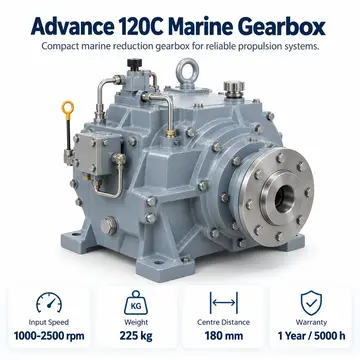
| 2200 rpm engine | Advance 120C, 2.96:1 | about 743 rpm | Small fishing and work boats |
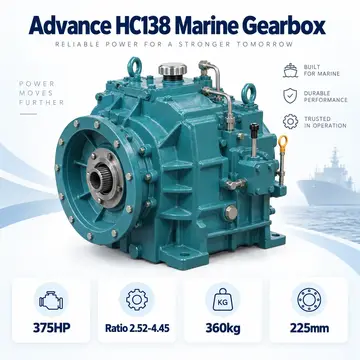
| Weichai WD618.C-16, 1700 rpm | Advance HC138, 3:1 | about 567 rpm | Inland cargo vessels |
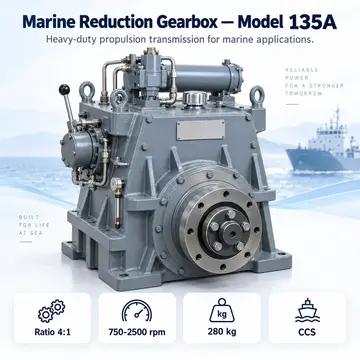
| SDEC D683, 2200 rpm | Advance 135A, 4:1 | about 550 rpm | Trawlers and workboats |
| Weichai WD618.C-16, 1700 rpm | Advance HC138, 4:1 | 425 rpm | Heavily loaded barges |
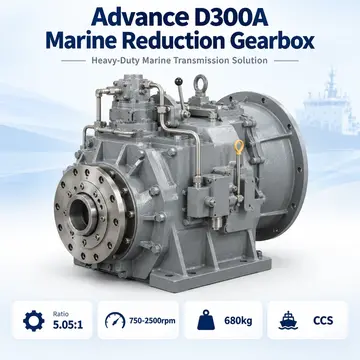
| 2200 rpm engine | Advance D300A, 5.05:1 | about 436 rpm | Tugs and slow, high-thrust vessels |
The 4:1 D683 pairing is the combination used on a 24 m trawler repower, and the WD618 and HC138 pairings come from an inland cargo fleet where 3:1 and 4:1 ratios were selected vessel by vessel to suit each hull and propeller.
How do I choose the right ratio for my propeller?
The ratio and the propeller are selected together. In a repower that keeps the existing propeller, the aim is simple: choose the ratio that reproduces the old propeller shaft speed at the new engine's rated rpm. If the old engine ran at 1800 rpm through a 3:1 gearbox (600 rpm at the shaft), a new engine rated at 2200 rpm needs a ratio of about 3.67:1 to keep the same shaft speed. The nearest available ratio is then chosen and the propeller pitch is checked or adjusted.
For a new build or a new propeller, the process usually runs the other way:
- Establish the largest propeller diameter the hull and tip clearance allow.
- Estimate the shaft speed that diameter should turn at, based on hull speed and load, using propeller design software or charts.
- Divide the engine rated rpm by that shaft speed to get the ideal ratio.
- Pick the nearest standard ratio from the gearbox family and fine-tune the propeller pitch.
Standard ratios come in steps. The Fada FD120 is offered at 1.48, 1.94, 2.45, 2.96 and 3.35:1, and the Advance HC138 at 2.52, 3.0, 3.57, 4.05 and 4.45:1. Propeller pitch absorbs the small difference between the ideal and the available ratio.
Is the gearbox strong enough for my engine's power and torque?
A gearbox is limited mainly by the torque it can transmit, so its capacity falls as input speed falls. Manufacturers express this in two common ways: as maximum power at a stated speed (for example, the Fada FD120 is rated at 340 HP at 2500 rpm and the HC138 at 375 HP at 2500 rpm), or as a transmitting capacity in kW per r/min. Capacity can also differ between ratios in the same family, so always check the line for the exact ratio you need.
To compare an engine with a gearbox, divide engine power in kW by rated rpm:
- A 320 metric hp (about 235 kW) engine at 2200 rpm needs about 0.107 kW per r/min.
- A 170 kW engine at 1700 rpm needs 0.100 kW per r/min.
The gearbox's rated capacity for the chosen ratio should be at least this figure, with margin for the engine's duty rating. The same torque check can be done directly: engine torque in N·m is 9550 × kW ÷ rpm, so 235 kW at 2200 rpm is roughly 1020 N·m at the flywheel, and at 4:1 the output shaft carries roughly four times that, less small losses.
Also check the input speed range. The Advance 135A, D300A and HC300 list 750–2500 rpm, and the 120C lists 1000–2500 rpm; the engine's rated and idle speeds should sit inside the gearbox's range.
What about thrust, flanges and couplings?
Once ratio and capacity are right, the mechanical interfaces decide whether the package bolts together cleanly.
| Check | Why it matters | Example values from data sheets |
|---|---|---|
| Rated propeller thrust | The gearbox thrust bearing carries propeller push into the hull | 120C: 25 kN; HC300: 50 kN; D300A: 60 kN |
| Bell housing (SAE size) | Must match the engine flywheel housing | HC300 and D300A: SAE 0 or SAE 1 |
| Input coupling | Transmits torque from the flywheel and damps torsional vibration | Sized to engine torque and flywheel pattern |
| Output flange | Must match the propeller shaft coupling | Confirm flange diameter and bolt circle |
| Centre distance | Sets vertical offset between input and output shafts | 120C and FD120: 180 mm; HC138: 225 mm; D300A: 355 mm |
| Weight and dimensions | Affect engine bed design and trim | D300A: about 680 kg; FD120: about 225 kg |
The centre distance is often overlooked in repowers. It changes the vertical offset between the crankshaft and the propeller shaft, so a gearbox with a different centre distance from the old one may require the engine bed to be raised or lowered to keep the shaft line straight.
On twin-engine installations, both gearboxes should have the same ratio, and propeller rotation must be planned for each side. Many marine reversing gearboxes can drive the output in either direction at equal ratio, but confirm this for the exact model before specifying handed propellers. On the twin-engine motor yacht repower, the gearbox ratio was chosen close to the originals so the existing propellers could be kept.
What information does a supplier need to match a gearbox?
Send the engine model, rated power and rpm, flywheel housing SAE size, duty rating, propeller diameter and pitch, shaft diameter, and the old gearbox model and ratio if it is a repower. MARS engineers use these to check ratio, capacity and interfaces, and can bench-run the engine and gearbox together before dispatch with a written report and video. Request a gearbox match with your engine and propeller data.
Frequently asked questions
What does a 3:1 gearbox ratio mean?
The engine turns three times for every one turn of the propeller shaft. At 2200 rpm engine speed, the propeller turns at about 733 rpm, with roughly three times the engine torque at the output.
Is a higher reduction ratio better?
Not in itself. A higher ratio suits a larger, slower propeller and heavy, slow vessels, while a lower ratio suits smaller propellers on lighter, faster hulls. The right ratio is the one that matches your propeller and hull.
Can I use a gearbox rated at 2500 rpm on a 1800 rpm engine?
Yes, if 1800 rpm is within the gearbox's input speed range and its capacity at 1800 rpm covers the engine's power. Because capacity is torque-limited, the permissible power at 1800 rpm is lower than the headline figure at 2500 rpm.
What happens if the gearbox ratio is wrong?
If the ratio is too low for the propeller, the engine cannot reach rated rpm and runs overloaded; if it is too high, the engine over-revs before full power is absorbed. Both waste fuel, and overload shortens engine life.
Do I need a new gearbox when I repower?
Not always, but the old gearbox must have enough capacity for the new engine, a matching bell housing and good internal condition. Many operators replace it at the same time to avoid a second haul-out.