Marine diesel engine maintenance is scheduled by running hours with a calendar backstop: daily checks before starting, oil and filter changes typically every 100–300 hours or once a year, raw-water pump, heat exchanger and anode checks on a similar cycle, and valve clearance and coolant renewal at around 500–600 hours or two years. The exact intervals come from the engine manufacturer's manual, and severe duty, poor fuel or warm seawater shorten them.
Key takeaways
- Use whichever comes first, hours or calendar time; oil and coolant age even when the engine does not run.
- Typical marine diesel oil change intervals are about 100–300 hours or annually, depending on engine size, oil grade, fuel sulfur and the manufacturer's manual.
- The raw-water side (strainer, impeller, heat exchanger, zinc anodes) causes more breakdowns at sea than the engine internals.
- Water and dirt in fuel are the leading causes of hard starting and injector damage, so drain the water separator daily.
- Regular oil analysis spots bearing wear, coolant leaks and fuel dilution long before a failure.
- Overhaul by condition, using blow-by, oil consumption, compression and oil analysis trends, not by hours alone.
Why do marine diesels need their own maintenance plan?
Marine engines work harder and in harsher conditions than most land engines. A workboat engine may run for hours at 70–90 percent load, in a hot engine room, cooled by seawater that carries salt, silt and marine growth. That is why marine diesel engine maintenance covers two circuits: the engine itself and the raw-water system that keeps it cool.
Boat engine maintenance also has to cope with long idle periods. Engines on yachts and seasonal fishing boats may sit for months, which allows moisture, acids and corrosion to build up. Calendar-based intervals exist for exactly this reason.
What does a marine diesel engine maintenance schedule look like?
The table below is a typical schedule for a high-speed marine diesel engine in the 50–500 kW class. It combines published intervals from several manufacturers' manuals, which range widely, so treat it as a planning template and replace each figure with the one in your engine's manual.
| Interval (whichever first) | Tasks |
|---|---|
| Daily / before each start | Check oil and coolant level, drain fuel-water separator, check raw-water strainer, look for leaks, check belts and gearbox oil |
| Every 50–100 h or monthly | Inspect zinc anodes, belt tension, battery terminals and air filter restriction; on a new or rebuilt engine, first oil change at around 50 h |
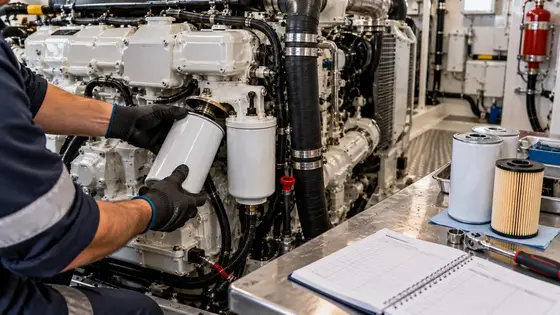
| Every 100–300 h or yearly | Change engine oil and oil filter, replace fuel filters, inspect raw-water pump impeller, flush or clean heat exchanger and aftercooler, check coolant additive |
| Every 500–600 h or 2 years | Adjust valve clearance, drain and renew coolant, replace thermostat if specified, inspect turbocharger, check engine mounts and shaft alignment |
| Every 1,000–2,000 h | Test or service injectors, pressure-test heat exchanger and coolers, inspect exhaust elbow and damper |
| By condition | Top-end or in-frame overhaul when trends show wear |
Keep a written or digital log of hours, dates, parts used and readings. A log turns individual services into a trend, which is what lets you plan repairs before they become breakdowns.
How often should you change diesel oil?
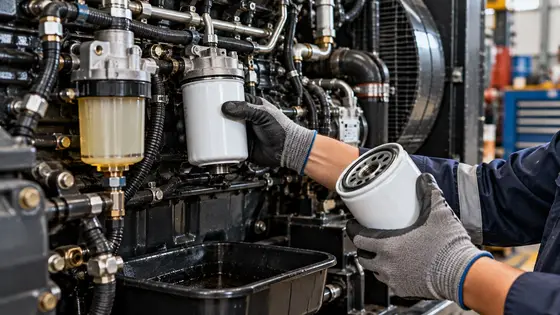
Change marine diesel oil at the interval in the manufacturer's manual, which for most small and mid-size marine diesels falls between roughly 100 and 300 running hours, and at least once a year. For example, some 5.9-liter marine engines call for oil and filters every 300 hours or one year, while some small generator engines call for every 100 hours.
Several conditions justify shorter diesel oil change intervals:
- High-sulfur fuel, which consumes the oil's alkaline reserve (TBN) faster.
- Long periods of idling or light load, which add soot and unburned fuel to the oil.
- High engine-room temperatures or frequent short runs.
- A new or freshly overhauled engine during running-in.
Use the oil specification and viscosity the manual names, such as an API CK-4 or CI-4 class oil for many modern high-speed diesels. Change the filter with every oil change, and always change oil before a winter layup so acids do not sit in the engine for months.
How do you maintain the cooling system?
The cooling system needs attention on both sides: fresh coolant inside the engine and seawater through the strainer, pump and heat exchanger. Most overheating at sea comes from the raw-water side.
- Clean the sea strainer whenever the boat has run in weed, silt or jellyfish, and check it daily.
- Inspect the raw-water pump impeller at least yearly and carry a spare; a single missing vane can block a heat-exchanger tube.
- Clean the heat exchanger and aftercooler tube stacks on the schedule above, and find any missing impeller pieces.
- Check zinc anodes often in warm seawater and replace them when about half is gone.
- Test coolant concentration and additive level, and renew coolant at the stated interval.
For a deeper look at how these systems work, see our guide to heat exchanger vs keel cooling.
How do you keep the fuel system healthy?
Clean, dry fuel is the single best protection for high-pressure pumps and injectors. Drain the fuel-water separator daily, replace primary and secondary filters on schedule, and keep tanks full during layup to limit condensation.
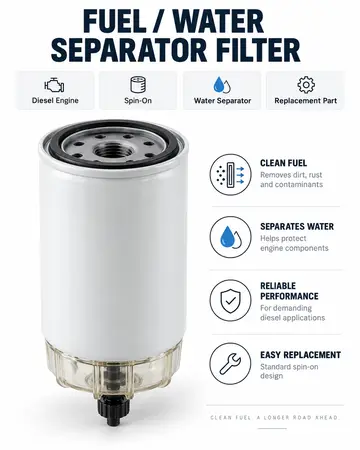
Spin-on separator elements such as the FS19517 / FS19599 series fuel-water separator filters are common on mid-size diesels; always match the micron rating and water-in-fuel sensor port to the original. Our fuel water separator guide explains how they work and when to drain them. If sludge or dark slime appears in the bowl, suspect microbial growth in the tank, and treat or polish the fuel rather than just changing filters.
What does oil analysis tell you?
Oil analysis is a laboratory test of a used oil sample that shows wear metals, contaminants and oil condition. Taken at every oil change, it is one of the most cost-effective tools in marine diesel engine maintenance.
| Finding | What it usually points to |
|---|---|
| Iron rising | Wear of liners, crankshaft, camshaft or gears |
| Copper, lead, tin rising | Bearing or bushing wear, or a cooler issue (copper) |
| Chromium | Piston ring wear |
| Aluminum | Piston or turbocharger wear |
| Silicon | Dirt entering through the air intake or a leaking air filter |
| Sodium with low potassium | Seawater in the oil, often from a leaking cooler |
| Glycol, sodium plus potassium | Coolant in the oil, often a head gasket or oil cooler |
| Fuel dilution, low viscosity | Injector or pump fault, or excessive idling |
Take samples from a warm engine at the same point each time, and trend the results rather than reacting to one figure.
How do you diagnose common marine diesel problems?
Marine diesel repair starts with simple checks before parts are replaced. The symptoms below have common, well-documented causes.
- Hard starting: air in the fuel, blocked filters, weak batteries or starter, low compression, or glow-plug or intake heater faults on smaller engines.
- Black smoke: overload or over-propping, a restricted air filter, a fouled turbocharger or faulty injectors.
- White smoke: cold start, water or coolant in the cylinders, or poor injection timing.
- Blue smoke: oil burning from worn rings, valve guides or turbo seals.
- Overheating: raw-water blockage, a failed impeller, a fouled heat exchanger, a stuck thermostat or a slipping belt.
- Rising oil consumption and crankcase blow-by: worn rings and liners, a sign that overhaul planning should start.
For boat engine repair beyond routine checks, use a technician trained on that engine family and genuine-specification parts. Our marine diesel engine parts and overhaul kits guide explains what goes into a top-end or in-frame job.
When should a marine diesel engine be overhauled?
Overhaul a diesel engine when condition data says so: falling compression, rising blow-by and oil consumption, persistent smoke, or oil analysis showing accelerating wear. Hours alone are a poor guide because load factor and maintenance quality vary so much.
A top-end overhaul covers cylinder heads, valves and injectors. An in-frame overhaul replaces pistons, rings, liners and bearings with the block in the boat. An out-of-frame overhaul removes the engine for crankshaft and block work. If the overhaul quote approaches the price of a new engine, compare the options; our boat repower cost guide helps with that decision.
MARS supplies filters, spare parts and complete replacement engines; to get a quotation, send your engine serial number and parts list.
Frequently asked questions
How often should I service a marine diesel engine?
Do daily pre-start checks, a routine service with oil, filters and raw-water checks about every 100–300 hours or annually, and a major service with valve adjustment and coolant renewal around 500–600 hours or two years. Follow the manufacturer's manual where it differs.
How long does diesel oil last in a boat engine?
Engine oil degrades with both hours and time, so even a lightly used boat engine should have its oil changed at least once a year. Change it before layup so acids and moisture do not remain in the crankcase.
What is included in a boat tune up for a diesel?
A diesel tune up usually covers oil and filter change, fuel filters, air filter, raw-water impeller, zinc anodes, belt inspection, valve clearance check and a sea trial with temperature and pressure readings. Diesels have no spark plugs, so most of the work is fluid, filter and cooling-system service.
What is the most common cause of marine diesel failure?
Overheating from raw-water system faults and fuel contamination are among the most common causes of breakdowns at sea. Both are largely preventable with daily checks and scheduled impeller, strainer and filter service.
How do I know my marine diesel needs an overhaul?
Warning signs include rising oil consumption, heavy crankcase blow-by, low or uneven compression, persistent blue or black smoke and oil analysis showing increasing wear metals. Confirm with a compression or blow-by test before deciding.
Can I extend oil change intervals with oil analysis?
Some operators of larger commercial engines extend intervals based on regular oil analysis, but only within limits the engine manufacturer approves. Without analysis, stay with the interval in the manual.