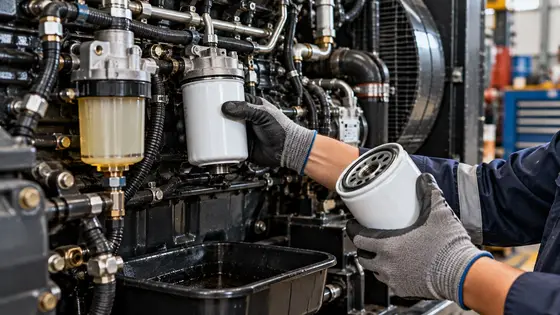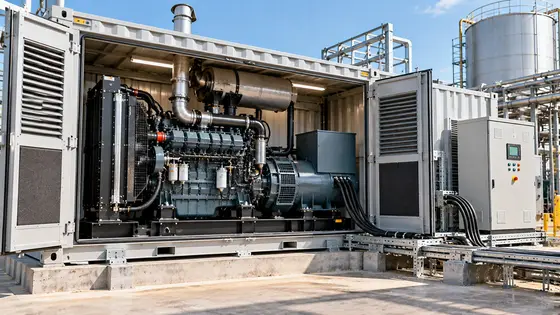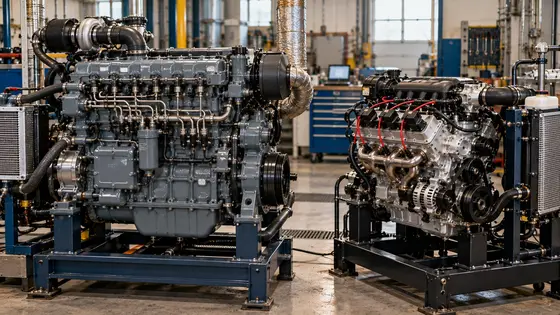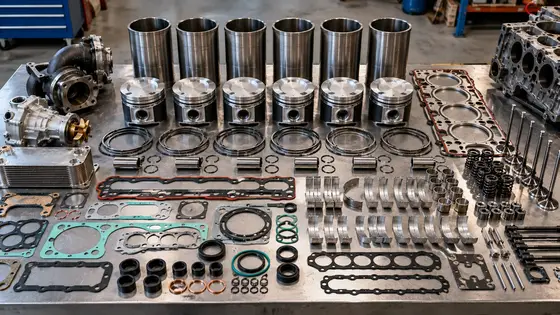
Marine diesel engine parts fall into three groups: routine service items such as filters, impellers and belts; wear parts such as injectors, seals and water-pump parts; and overhaul kits that renew the pistons, rings, liners, bearings and gaskets in one job. To order correctly, identify the engine by its serial or arrangement number, decide between an in-frame or out-of-frame overhaul, and buy parts to the original part numbers or a verified cross-reference.
Key takeaways
- An engine overhaul kit bundles the parts for one overhaul: typically pistons, rings, liners, pins, rod and main bearings and gasket sets, with contents that vary by kit type and supplier.
- In-frame kits suit overhauls with the engine left in the hull; out-of-frame kits add the lower gaskets, seals and parts reachable only with the engine removed.
- Many marine engines share internal parts with their truck or industrial base engine, but marine-specific cooling, exhaust and drive parts do not interchange.
- The engine serial number and nameplate data, not the model name alone, are the reliable way to identify parts.
- Onboard spares should cover the failures most likely to stop the vessel: filters, impellers, belts, injectors, hoses and gaskets.
What are the main parts of a marine diesel engine?
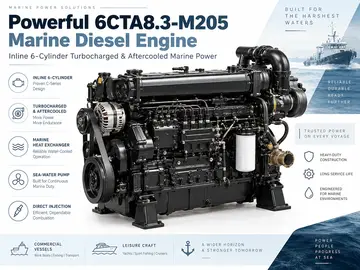
A marine diesel engine is built from the same core systems as any diesel, plus a marine cooling and exhaust package. Knowing which system a part belongs to makes it easier to find, cross-reference and stock.
| System | Key components | Typical replacement pattern |
|---|---|---|
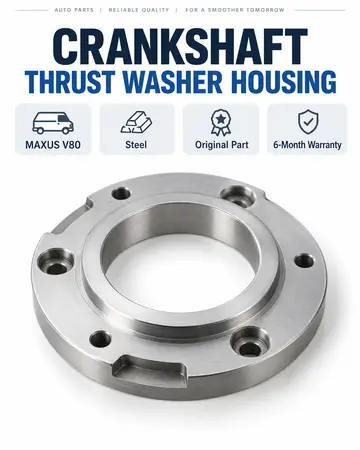
| Engine block and bottom end | Block, crankshaft, connecting rods, main and rod bearings, thrust washers | Bearings at overhaul; crankshaft reground or replaced if worn |
| Power cylinder | Pistons, piston rings, pins, cylinder liners or sleeves | Renewed at in-frame or out-of-frame overhaul |
| Cylinder head and valvetrain | Heads, valves, guides, seats, springs, rocker gear, camshaft, tappets | Top-end overhaul; valve clearance at service |
| Fuel system | Lift pump, injection pump or common-rail pump, injectors, filters, water separator | Filters at service; injectors tested or replaced by hours |
| Air and exhaust | Air filter, turbocharger, aftercooler, water-cooled exhaust manifold, exhaust elbow | Air filter by restriction; turbo and elbow by inspection |
| Cooling | Fresh-water pump, raw-water pump and impeller, heat exchanger, thermostat, zinc anodes | Impellers and anodes often yearly; pumps rebuilt by condition |
| Lubrication | Oil pump, oil cooler, oil filter, pressure relief valve | Filter every oil change; cooler cleaned or pressure-tested |
| Electrical and starting | Starter, alternator, sensors, wiring harness, glow plugs on small engines | By condition |
These are also the parts of the main engine that class surveyors and superintendents track in a planned maintenance system. For the service intervals behind each one, see our marine diesel engine maintenance schedule.
What is in an engine overhaul kit?
An engine overhaul kit, also called an engine rebuild kit, is a matched set of parts for renewing the wearing surfaces of an engine in one job. Contents are not standardized, so always ask for the kit's parts list before ordering.
| Kit type | Typical contents | When it is used |
|---|---|---|
| Top-end or head gasket kit | Head gaskets, valve cover and manifold gaskets, seals, O-rings | Cylinder head removal, valve work, injector sleeve work |
| Re-ring kit | Piston rings, gaskets and seals, sometimes liners, no pistons | Light wear with pistons and bottom end in good condition |
| In-frame overhaul kit | Pistons, rings, pins and retainers, liners, upper gasket set, often rod and main bearings and oil pan gasket | Engine stays in the hull; crankshaft and block are serviceable |
| Out-of-frame overhaul kit | In-frame contents plus lower gasket set, front and rear crank seals, thrust washers and most remaining seals | Engine removed; crankshaft, block or major damage to address |
Terms such as "master engine rebuild kit", "complete engine rebuild kit" or "full engine rebuild kit" are used loosely. Some include camshaft, timing parts and oil pump; others are little more than a gasket set with bearings. Compare kits line by line.
In-frame or out-of-frame: which overhaul kit do I need?
Choose an in-frame kit when the crankshaft is within limits, the block has no cracks or cavitation damage and the engine can be worked on in place. Choose out-of-frame when the crankshaft needs regrinding, the block needs machining, there has been a major failure such as a dropped valve or spun bearing, or the engine has to come out anyway.
On wet-liner engines, an in-frame overhaul is common because liners can be pulled with the engine still on its mounts. On parent-bore engines with no replaceable liner, worn bores need honing or boring, which often pushes the job out of frame. Before committing, measure what you can:
- Crankshaft journal diameters and out-of-round, against the service limits.
- Liner or bore wear, ovality and cavitation pitting.
- Main bearing housing alignment if a bearing has failed.
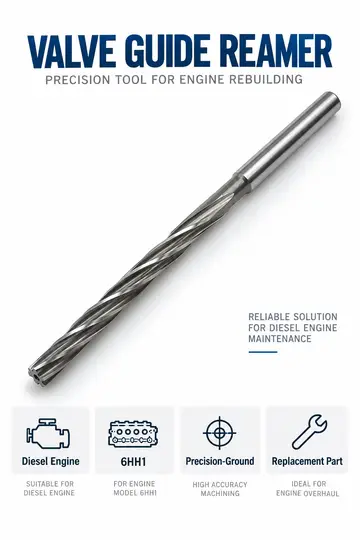
- Cylinder head flatness and valve guide wear; worn guides are reamed and fitted with new ones using tools such as a valve guide reamer.
If the measurements show the block or crankshaft is beyond repair, compare the overhaul cost against a replacement engine or long block; our guide to long block vs short block vs complete engine covers that choice.
Should I buy genuine, OEM-equivalent or aftermarket marine diesel engine parts?
Genuine parts come through the engine maker's own channel; OEM-equivalent parts are made by the same component suppliers or to the same specification; aftermarket marine engine parts are made by third parties to their own specification. All three can work, but quality spread is widest in the aftermarket.
Questions that separate good diesel spare parts from poor ones:
- Does the part carry a traceable part number that cross-references to the original?
- Are materials and dimensions documented, for example piston ring coatings, bearing alloy and liner hardness?
- Is the kit matched as a set, so rings suit the pistons and liners supplied?
- Is there a written warranty, and does it cover the labor of a failed overhaul?
- For classed vessels, is the part acceptable to the classification society for that machinery?
Used marine engine parts can be useful for obsolete engines, but treat bearings, rings, gaskets and seals as single-use, and buy only major castings or assemblies used after inspection.
How do I identify the right parts for my engine?
Identify marine diesel engine parts from the engine's nameplate and serial number, because the same model name can cover many builds with different pistons, injection systems and cooling packages. Record the following before you request a quote:
- Engine model and full serial or engine number, from the nameplate or block stamp.
- Arrangement, configuration or build number where the maker uses one.
- Rated power and rpm, which hint at the piston, turbo and fuel settings.
- Photos of the old part with any cast or stamped numbers.
- For bearings and pistons, any oversize or undersize stamped on the old parts.
Many marine engines are marinized versions of truck or industrial engines, so internal parts such as pistons, bearings and gaskets often share part numbers with the base engine. Marine-specific items, including heat exchangers, raw-water pumps, exhaust manifolds and gearbox couplings, are usually unique and must be ordered against the marine build.
Which ship spares should be kept onboard?
Onboard spares should cover the failures that would stop the vessel far from a port. Requirements depend on flag, class and owner policy, but a practical vessel spare parts list for a high-speed marine diesel includes:
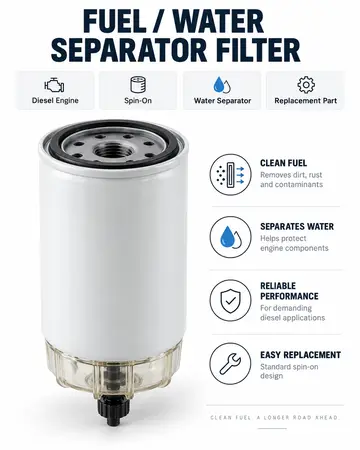
- A full set of fuel, oil and air filters, plus fuel-water separator elements such as the FS19517 / FS19599 series.
- Raw-water pump impellers and a pump repair kit.
- Drive belts, hoses and hose clamps.
- At least one injector, and the seals to fit it.
- Thermostat, zinc anodes and a top-end gasket set.
- Engine oil and coolant for at least one full change.
For a worked example of how an operator standardized filters across a fleet, see the offshore vessel engine parts project.
How do I order marine diesel engine parts from an export supplier?
Send one consolidated list with part numbers, quantities, engine serial numbers and required delivery port, rather than one-off requests. A consolidated order reduces freight cost per part and lets the supplier check interchangeability in one pass.
MARS is a Shanghai-based export supplier of engines and spare parts. Stock items ship promptly in export wooden-box packing, FOB or CIF Shanghai. To start, send your parts list and engine nameplate photos.
Frequently asked questions
What is included in an engine rebuild kit?
A typical diesel engine rebuild kit includes pistons, piston rings, wrist pins, cylinder liners, rod and main bearings and gasket sets. Out-of-frame kits add the lower gaskets, crankshaft seals and thrust washers; always check the parts list because contents vary.
What is the difference between an in-frame and out-of-frame overhaul kit?
An in-frame kit renews the power cylinders and bearings with the engine left in place. An out-of-frame kit adds the seals, gaskets and parts needed when the engine is removed and fully stripped.
Who makes the best engine rebuild kits?
The best kit is one built to the original specification for your exact engine build, with traceable part numbers, matched components and a written warranty. Genuine and reputable OEM-supplier kits are the safest choice for engines in commercial service.
Can truck engine parts be used on a marine diesel?
Often, for internal parts such as pistons, bearings and gaskets, when the marine engine shares the same base engine and part numbers. Marine-specific parts such as heat exchangers, raw-water pumps and exhaust manifolds do not interchange, so confirm every part by number.
How do I find the right part number for my marine engine?
Use the full engine serial number and build or arrangement number from the nameplate, then check the maker's parts catalog or ask your supplier to cross-reference it. The model name alone is often not enough.