A marine diesel engine should be bought on five things: its duty rating, its power at a stated rated rpm, its speed class, its cooling system and the emissions tier the vessel must meet. Start from how many hours a year the boat runs at load and what the propeller needs, then pick the smallest engine whose rating covers that duty with margin, and confirm it fits the engine room, the gearbox and the flag or class rules.
Key takeaways
- A marine diesel is a marinized engine with closed-circuit cooling, a sea-water pump, water-cooled exhaust parts and corrosion protection; a land engine dropped into a boat is not the same thing.
- Power figures only compare fairly at the same unit (kW), the same rated rpm and the same duty rating.
- High-speed diesels (above roughly 1,000 rpm) power most boats and workboats; medium-speed and low-speed engines power larger ships.
- Under MARPOL Annex VI Regulation 13, marine diesel engines above 130 kW must meet IMO NOx limits, with Tier III applying inside designated emission control areas.
- Engines with a heavier, continuous rating last longer at high load than the same block on a pleasure rating.
- Send the supplier the vessel data, old engine data, gearbox ratio and propeller size, not just a horsepower figure.
What makes a marine diesel engine different from a land engine?
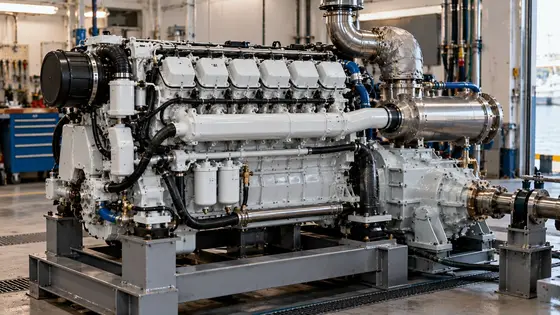
It is built or converted ("marinized") to run in a hot, enclosed, damp engine room and to reject heat into seawater. The core block may be shared with truck or industrial engines, but the cooling, exhaust, mounting and electrical parts are specific to marine service.
Typical marine-specific features include:
- Heat-exchanger or keel cooling, so the block runs on fresh coolant while seawater only passes through the exchanger.
- A raw-water pump, usually with a flexible impeller, to move seawater through the exchanger, coolers and wet exhaust.
- Water-cooled exhaust manifold and turbocharger housing, which keep engine-room surface temperatures down.
- Marine gearbox interface, with an SAE flywheel housing that matches a reversing reduction gear.
- Sacrificial zinc anodes and marine-grade paints and fittings against corrosion.
An inboard engine is simply one mounted inside the hull and driving a propeller through a shaft, V-drive or sterndrive. If you are still choosing between propulsion layouts, our guide to inboard vs outboard vs sterndrive compares them.
What types of marine diesel engines are there?
Marine diesels are usually grouped by crankshaft speed, because speed class drives size, weight, fuel tolerance and where the engine is used. The boundaries below are conventional rather than legal definitions.
| Speed class | Typical rated speed | Cycle and layout | Typical use |
|---|---|---|---|
| High-speed | Above about 1,000 rpm, often 1,500–2,800 rpm | Four-stroke, inline 4/6 or V8–V16 | Fishing boats, workboats, yachts, ferries, gensets |
| Medium-speed | About 300–1,000 rpm | Four-stroke, inline or V, trunk piston | Tugs, dredgers, offshore vessels, ship auxiliaries |
| Low-speed | Below about 300 rpm | Two-stroke crosshead, direct drive | Large cargo ships, tankers, container ships |
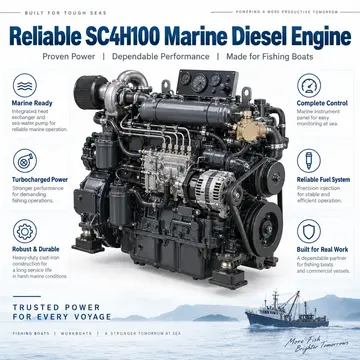
Most buyers of small marine diesel engines and workboat engines are in the high-speed class. A compact four-cylinder such as the 73.5 kW SC4H100 suits small fishing and harbor boats, while V12 engines such as the 1,000 hp 12M33 marine engine cover tugs and larger ferries.
At the other extreme, the biggest marine engines are low-speed two-stroke crosshead units for container ships. The largest of these deliver around 80,000 kW at about 100 rpm and weigh over 2,000 tonnes. For a fuller explanation of the two cycles, see ship engines: two-stroke vs four-stroke.
Which duty rating should I buy?
Buy the rating that matches your real load pattern: continuous or heavy duty for vessels that run near full load for long hours, and lighter ratings only for boats that cruise well below full power. The same basic engine often carries a higher kW figure on a light-duty or pleasure rating, so comparing headline power across ratings is misleading.
Rating definitions vary by manufacturer, so read the data sheet. As a rule of thumb, trawlers, tugs, push boats and dredgers need a continuous rating; ferries, crew boats and patrol boats usually suit a medium-duty rating; and private yachts can use a high-output rating because they log few hours at full throttle. Power is generally declared to ISO 3046-1 or ISO 8665 conditions, which fix the reference air temperature, pressure and humidity, so check which standard the sheet uses. Our workboat repower guide explains ratings with vessel examples.
How do I size a marine diesel engine?
Size the engine from the power the hull and propeller actually absorb at your target speed, then add a working margin; do not start from the largest engine that fits. Follow these steps:
- Start from known performance. If the old engine drove the boat well, match its power and rated rpm closely so the gearbox ratio and propeller can stay.
- Convert everything to kW. One metric horsepower (PS) is 0.7355 kW and one mechanical horsepower is about 0.746 kW, so "300 hp" can mean two different numbers.
- Check the propeller law. Propeller power demand rises roughly with the cube of shaft speed, so a small rpm gain needs a large power increase.
- Leave margin for the duty. Many operators aim for a normal cruising load of roughly 70–85 percent of the rated power, which leaves reserve for fouling, weather and payload.
- Match the gearbox. The reduction ratio must bring the propeller to its design speed at rated engine rpm, and the gearbox must be rated for the engine's power and torque.
- Confirm the physical fit. Compare length, width, height, weight and crankshaft centerline with the engine bed and shaft line.
Oversizing is not free. An engine that spends most of its life at very light load can suffer from incomplete combustion, carbon build-up and fuel dilution of the oil, often called wet stacking.
Inboard diesel or gasoline inboard engine?
For commercial vessels and most boats over about 10 m, an inboard diesel engine is the normal choice because of lower fuel consumption, higher torque at low rpm and lower fire risk. Gasoline inboard engines are lighter and cheaper to buy but burn more fuel per kWh and need ignition-protected electrical parts and careful ventilation.
Fuel efficient marine engines are, in practice, well-matched diesels running at a sensible load. Modern high-speed marine diesels typically consume roughly 200–240 grams of fuel per kWh near rated load; the exact figure is on the manufacturer's fuel curve. Picking the right propeller and keeping the hull clean often saves more fuel than switching engine models.
What emissions rules apply to marine engines?
For ships under IMO conventions, MARPOL Annex VI Regulation 13 applies NOx limits to marine diesel engines above 130 kW. Tier II covers ships built from 1 January 2011, and Tier III, about 80 percent lower than Tier II, applies inside NOx emission control areas: North America and the US Caribbean for ships built from 2016, and the Baltic and North Sea for ships built from 2021.
Engines above 130 kW on such ships need an EIAPP (Engine International Air Pollution Prevention) certificate. In US waters, the EPA's marine rules sort engines by displacement per cylinder: Category 1 is below 7 liters per cylinder for Tier 3 and Tier 4, Category 2 runs from 7 to under 30 liters, and Category 3 is 30 liters and above. Tier 4 applies to commercial engines above 600 kW. Always confirm the tier, certificate and any class approval the flag state needs before ordering.
Should I buy a new, remanufactured or second-hand marine engine?
New engines give a full factory warranty, current emissions certificates and a known history, which makes them the default for classed vessels and fleet standardization. Remanufactured engines can make sense for an identical replacement, and second hand marine diesel engines are cheapest but carry the most risk.
If you are weighing those options, read remanufactured vs rebuilt vs new diesel engines. With any used engine, ask for running hours, oil analysis, a compression or blow-by test and proof of the emissions certificate.
What should I send a marine engine supplier?
A useful quotation request gives the supplier enough data to match engine, rating and gearbox without guessing. Include:
- Vessel type, length, displacement, service speed and daily running hours.
- Old engine model, power, rated rpm and gearbox model and ratio.
- Propeller diameter, pitch and blade count, and shaft diameter.
- Cooling type (heat exchanger or keel cooler) and wet or dry exhaust.
- Engine room dimensions and photos of the existing installation.
- Flag, class and emissions tier requirements, plus delivery port and date.
MARS, a Shanghai-based export supplier, matches engine and gearbox before quoting and run-tests the package with a written report and video before dispatch, shipping FOB or CIF Shanghai. To get a matched proposal, send your vessel details.
Frequently asked questions
What is the best marine diesel engine?
There is no single best model; the best engine is correctly rated for your duty cycle, matched to your gearbox and propeller, and supported by parts and service where the boat operates. Parts availability in your region often matters more than small differences in specifications.
What size marine diesel engine does my boat need?
Start from the power the previous engine delivered at its rated rpm, or from a naval architect's power estimate, then choose an engine whose duty rating covers that load with roughly 15–30 percent reserve. Convert all figures to kW before comparing.
What is a good small marine diesel for a sailboat?
Sailboat diesel engines are usually small two- to four-cylinder units of roughly 10–60 kW, chosen by hull length and displacement. Prioritize low weight, heat-exchanger cooling, a matching sail-drive or shaft gearbox and good local parts support.
What is a complete drop-in marine engine?
A complete drop-in marine engine is supplied fully marinized and dressed, with cooling system, exhaust parts, starter, alternator, instruments and often the gearbox fitted, so it can be installed with minimal extra parts. It still needs checking against the existing mounts, shaft line and exhaust.
How long does a marine diesel engine last?
Service life depends mainly on duty rating, load factor and maintenance, and manufacturers publish expected overhaul intervals in their documentation. A well-maintained engine on the correct rating usually runs many thousands of hours before a major overhaul is needed.
How much does a marine diesel engine cost?
Price depends on power, rating, brand, emissions tier, class certification and the scope of supply, such as gearbox, panel and spares. Ask for itemized quotations on the same basis, as prices vary by market and year.