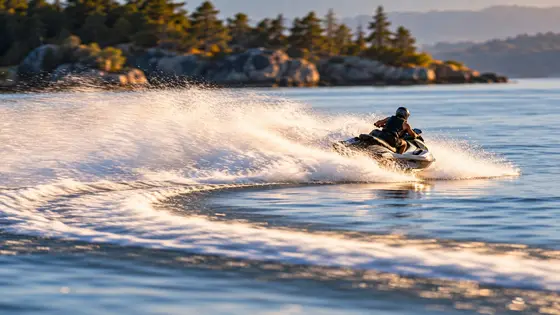
How fast do jet skis go? Most current personal watercraft (PWC) reach about 40 to 67 mph: 60 hp rec-lite models top out around 42 mph, 90–130 hp models around 50–54 mph, and supercharged 230–325 hp flagships are electronically limited to roughly 67 mph. Dry weights run from about 425 lb for the lightest models to more than 900 lb for large touring and fishing craft, and fuel tanks range from about 8 to 21 gallons.
Key takeaways
- Typical jet ski top speeds are about 42 mph at 60 hp, 50–54 mph at 90–130 hp, 52–65 mph at 155–180 hp and about 67 mph for supercharged models.
- The roughly 67 mph ceiling on flagship models comes from a voluntary manufacturers' agreement with the U.S. Coast Guard, outlined in 1999, not from a federal speed law.
- The most powerful production PWC in 2026 are rated at 325 hp, and their advantage over 230 hp models is acceleration rather than top speed.
- Dry weight ranges from about 425 lb (rec-lite) to roughly 900 lb (touring and fishing); curb weight with fuel and fluids can exceed 1,000 lb on the largest models.
- Lengths run from about 111 inches (9.25 ft) to about 147 inches (12.2 ft).
- Fuel burn ranges from about 2 gallons per hour on the smallest models at full throttle to 20–25 gallons per hour on supercharged flagships, dropping to roughly 3–4 gallons per hour at cruise.
How fast do jet skis go by horsepower?
Jet ski top speed rises with power up to about 67 mph, then stops rising because of factory speed limiting. The table below shows typical figures from independent tests; real-world speed varies with rider weight, load, water conditions, temperature and pump condition, and manufacturers generally do not publish official top speeds.
| Power class | Typical models | Typical top speed |
|---|---|---|
| 60 hp | Rec-lite, two-seat | About 42 mph |
| 90 hp | Rec-lite, two- or three-seat | About 50 mph |
| 110–130 hp | Recreation, entry fishing, some stand-ups | About 46–54 mph |
| 155–180 hp | Recreation and touring | About 52–65 mph |
| 230–250 hp (supercharged) | Touring, performance, tow sports | About 67 mph (limited) |
| 300–325 hp (supercharged) | Performance and luxury touring | About 67 mph (limited) |
For a beginner or rental guest, 50 mph is already very fast on a craft with no hull around the rider. That is why rental fleets usually run 90–170 hp models with learning modes or speed limiting enabled.
Why are jet skis limited to about 67 mph?
In November 1999 the U.S. Coast Guard outlined a voluntary 65 mph top-speed cap with several PWC manufacturers, allowing about 2 mph of production variance. In practice, high-output models sold in the US are electronically limited to around 67 mph. It is an industry arrangement rather than a federal regulation, and local speed limits on the water still apply.
What is the fastest jet ski in the world?
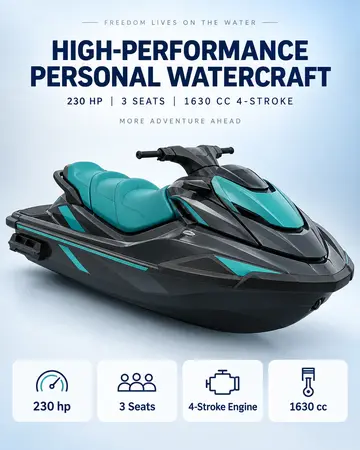
The fastest production jet skis on the market are the 300–325 hp supercharged performance models. Stock, they are limited to roughly 67 mph like other flagships, so the real differences are acceleration, handling and how long they hold top speed in rough water. Modified race craft go considerably faster, but they are not production machines and are outside any warranty.
How much does a jet ski weigh?
A jet ski weighs about 425 to 920 lb dry, depending on size, and roughly 100–150 lb more once it is fueled and filled with oil and coolant. Rec-lite models are the lightest personal watercraft, while touring and fishing models are the heaviest.
Manufacturers quote either dry weight (no fuel, oil or other fluids) or curb weight (ready to ride). Gasoline weighs about 6 lb per US gallon, so a full 18.5-gallon tank alone adds around 110 lb. Always compare like with like.
| Type | Typical dry weight | Typical length | Fuel capacity |
|---|---|---|---|
| Rec-lite | About 425–460 lb (193–209 kg) | About 111–120 in | About 8 gal (30 L) |
| Recreation | About 740–790 lb (336–358 kg) | About 131–136 in | About 18.5 gal (70 L) |
| Touring | About 780–850 lb (354–386 kg) | About 136 in | About 18.5 gal (70 L) |
| Performance | About 780–850 lb (354–386 kg) | About 130–136 in | About 18.5 gal (70 L) |
| Fishing and utility | About 785–920 lb (356–417 kg) | About 131–147 in | About 18.5 gal (70 L) |
| Large luxury touring (curb weight) | About 1,050–1,075 lb (476–488 kg) | About 133 in | About 20.6 gal (78 L) |
These figures come from current manufacturer data sheets for representative models and are indicative only. Check the exact model and options, because audio systems, braking hardware and accessory packages each add weight.
Why does jet ski weight matter?
Weight affects towing, launching, lifts and storage more than riding. A double trailer carrying two large touring PWC can approach or exceed 2,500 lb, which may exceed the towing rating of a small car. For resorts, weight decides how many staff it takes to beach or dock a craft, and which lifts or floating ports are suitable.
How long is a jet ski?
Most jet skis are about 9 to 12 feet long. Rec-lite models are around 111–120 inches, recreation and touring models about 130–136 inches, and the largest fishing or expedition models about 147 inches. That puts every sit-down PWC well under the 16-foot limit of the Coast Guard's Class A category.
What engine does a jet ski have?
A modern jet ski motor is typically a fuel-injected, three-cylinder four-stroke gasoline engine of about 0.9 to 1.8 liters, coupled directly to the jet pump by a driveshaft. There is no gearbox: engine speed sets impeller speed, and thrust is controlled with the throttle.
Jet ski horsepower ranges
Jet ski horsepower spans about 60 hp on the smallest rec-lite models to 325 hp on the most powerful supercharged models. Naturally aspirated engines cover roughly 60–180 hp; anything above that is boosted. Horsepower figures are manufacturer ratings, and test methods are not always published, so treat cross-brand comparisons with caution.
Supercharged vs turbo jet skis
Current high-output production PWC use superchargers, which are driven mechanically by the engine and give strong, immediate response from low rpm. Turbocharged PWC are mostly aftermarket conversions or race builds. A supercharged jet ski needs more maintenance than a naturally aspirated one: the supercharger has its own inspection or rebuild interval, and the engine is more sensitive to fuel quality and overheating. For high-hour rental or patrol work, naturally aspirated engines are usually the lower-risk choice.
Are 2-stroke jet ski engines still made?
Two-stroke jet ski engines dominated until the early 2000s, when tighter emissions rules from the US EPA and California regulators pushed manufacturers to four-stroke and cleaner direct-injection designs. Mainstream sit-down models are now four-stroke. Two-strokes are still common in the used market, in older stand-ups and in racing, and they are lighter and simpler but use more fuel and need top-end rebuilds sooner.
How far can a jet ski go on a tank of gas?
A jet ski can typically travel about 40 to 170 miles on a tank, depending on engine size, tank capacity and speed. Riding at full throttle can empty a supercharged model's tank in under an hour, while cruising at moderate speed stretches the same tank to several hours.
| Riding style | Typical fuel burn | Typical economy | Typical time per tank |
|---|---|---|---|
| Rec-lite at full throttle | About 2–2.5 gal/h | Up to about 20 mpg | Several hours on an 8-gal tank |
| Mid-size at full throttle | About 8–15 gal/h | About 3–6 mpg | About 1–2 hours |
| Supercharged at full throttle | About 20–25 gal/h | About 2–3 mpg | Under 1 hour |
| Most models at best cruise | About 3–4 gal/h | About 7–9 mpg | About 4–7 hours |
These are indicative figures from independent tests and vary with load, sea state, trim and rider style. For range planning, most riders and tour operators keep a reserve of at least a quarter to a third of the tank. Tour operators should plan routes on measured fuel burn from their own fleet, not on brochure figures.
Which jet ski specs matter for a rental or resort fleet?
For fleet buyers, the most useful specs are not top speed but durability, stability and running cost. A good fleet spec sheet covers:
- Engine type. Naturally aspirated 90–170 hp engines balance performance with lower maintenance.
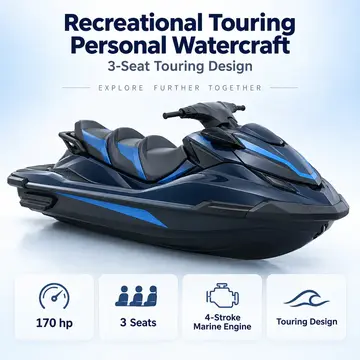
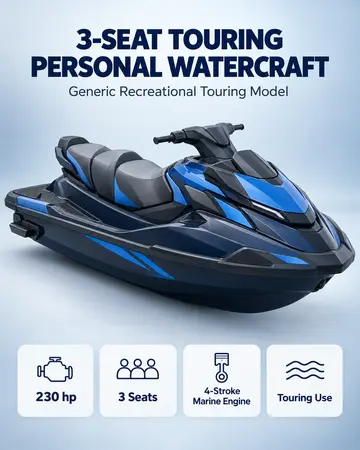
- Seating and stability. Three-seat hulls in the 130–136 inch range are more forgiving for beginners.
- Speed and mode limiting. A learning or eco mode lets staff cap speed for first-time riders.
- Braking and reverse. Electronic braking and reverse reduce dock collisions.
- Fuel capacity and burn. An 18.5-gallon class tank gives a useful buffer between refuels; plan refueling around measured burn from your own sessions.
- Weight. Lighter craft are easier to beach, lift and recover.
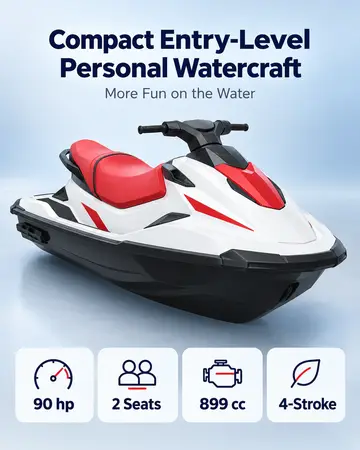
The compact 90 hp model suits light-duty and first-time use, the 170 hp recreation model is a common core-fleet choice, and the supercharged 300 hp performance model is for experienced riders. For a broader overview of hull types, see what a personal watercraft is and how it works, and for budgets see how much a jet ski costs.
MARS supplies the full personal watercraft range and can confirm exact data-sheet specs for each model and market before you order.
Frequently asked questions
How fast can a 300 hp jet ski go?
In stock form, a 300 hp jet ski is electronically limited to about 67 mph in most markets. The extra power mainly improves acceleration and pulling power rather than top speed.
What is the lightest personal watercraft?
Rec-lite models are the lightest sit-down PWC, at roughly 425–460 lb dry. Some stand-up models are lighter still, but they carry only one rider.
How much does a jet ski weigh with a trailer?
A single mid-size PWC on a single trailer typically totals around 1,000–1,400 lb ready to tow, depending on the trailer and fuel load. Check the actual trailer weight and your vehicle's towing rating.
How many hours of riding do you get on a tank of gas?
At cruising speed most jet skis run about 4–7 hours on a full tank, while hard full-throttle riding can empty the tank in 1–2 hours or less. Supercharged models use fuel fastest.
Can a jet ski motor be used in a boat?
PWC-derived engines are used in some small jet boats built by the same manufacturers, but swapping a jet ski motor into a different boat is rarely practical. Cooling, exhaust, mounting, controls and the pump all have to be engineered together.
What is a rec-lite jet ski?
A rec-lite jet ski is a small, light, lower-power personal watercraft, typically 60–90 hp with an 8-gallon tank. It is designed for low purchase cost, easy towing and beginner-friendly riding.
Specifying a fleet and need verified data sheets for each model? Ask us for a quote with your intended use and quantities.