To size a marine generator, list every AC load that can run at the same time, add the starting surge of the largest motor or compressor, and choose a set whose prime rating puts normal running load at roughly 50–80 percent of its capacity. On boats this usually means a few kW for a small cruiser and tens to hundreds of kW for workboats and ships, where at least two auxiliary generating sets are normally fitted.
Key takeaways
- A marine genset is a constant-speed engine coupled to an alternator, with marine cooling, wet or water-cooled exhaust, controls and a common base frame.
- Generators run at fixed speed for their frequency: with a four-pole alternator, 1,500 rpm gives 50 Hz and 1,800 rpm gives 60 Hz.
- Genset output is rated in kW at a stated power factor, usually 0.8, so kVA equals kW divided by 0.8; ISO 8528-1 defines continuous, prime and standby ratings.
- Electric motors started direct-on-line typically draw around six times their running current for a moment, which often decides generator size.
- Diesel is the standard fuel for boat generators; gasoline sets need ignition-protected components and carry a higher carbon monoxide risk.
- SOLAS ships need at least two main generating sets, sized so essential services continue if one set stops.
What is a marine generator?
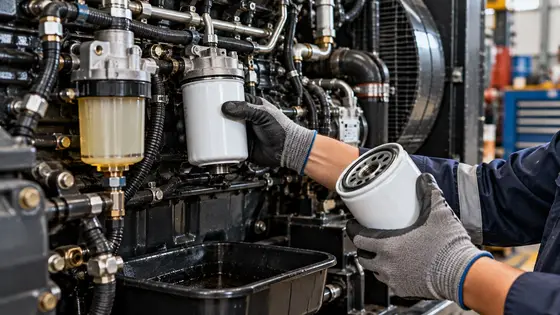
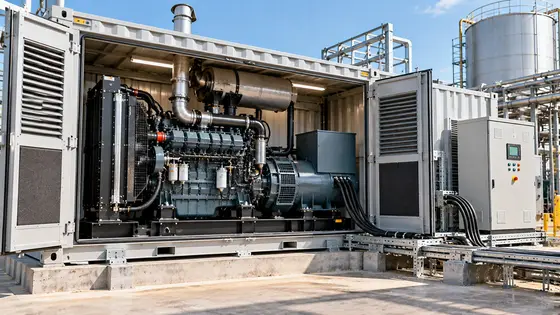
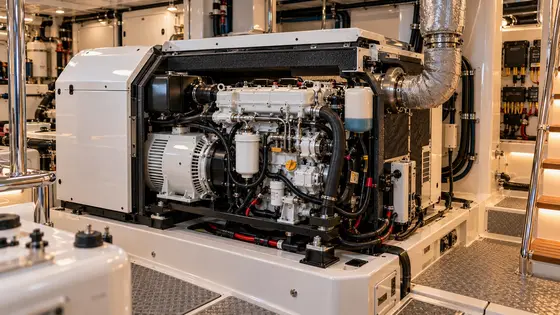
A marine generator, often shortened to marine gen or genset, is an engine and alternator package built to produce AC power on board. It differs from a land generator in its cooling, exhaust, mounting and safety features.
A typical marine diesel generator includes:
- A constant-speed diesel engine with a governor that holds frequency steady as load changes.
- An alternator, usually brushless, with an automatic voltage regulator.
- Heat-exchanger or keel cooling, with a raw-water pump on heat-exchanger sets.
- A water-cooled exhaust manifold and wet exhaust elbow, which keep surface temperatures safe in an enclosed space.
- A common base frame on anti-vibration mounts, sometimes with a sound shield.
- Controls and protection, including low-oil-pressure and high-temperature shutdowns.
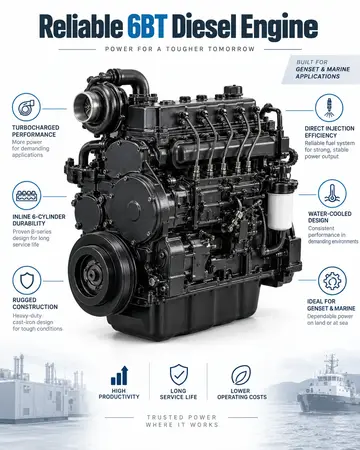
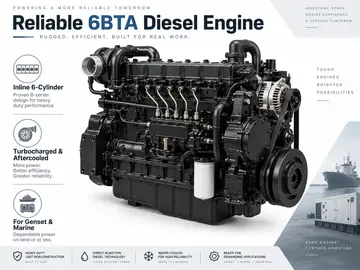
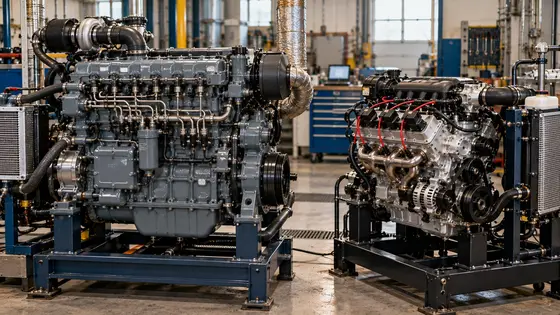
On ships, the engine driving the generator is called the auxiliary engine, or aux engine, to distinguish it from the main propulsion engine. The same engine families often serve both roles: the 6BT-type genset and marine engine is built in propulsion and constant-speed genset versions, which our 6BT vs 6CTA8.3 comparison explains in detail.
How do I size a marine generator?
Size the generator for the largest combination of loads that will realistically run together, plus starting surges, then leave headroom. Follow these steps:
- List every AC load with its running power in watts or kW: air conditioning, water heater, cooking, battery chargers, pumps, winches, refrigeration and electronics.
- Decide which loads run together. A water heater and an induction hob may never be used at the same time as a full air-conditioning load; a load-management system can enforce that.
- Add the largest starting surge. Compressors and pumps draw several times their running current for a second or two when starting direct-on-line.
- Target 50–80 percent load. Aim for a normal running load of roughly half to three-quarters of the set's prime rating.
- Avoid chronic light loading. A diesel generator that runs for long periods below about 30 percent load can suffer wet stacking, with unburned fuel and carbon in the exhaust and oil.
- Check the supply voltage and frequency of the equipment: 230 V/50 Hz or 120/240 V/60 Hz on small craft, and 400 V/50 Hz or 440–480 V/60 Hz three-phase on larger vessels.
The table below shows an illustrative load list for a 15–20 m motor yacht or crew boat. Real figures vary by equipment, so use the nameplate values.
| Load | Typical running power | Starting behavior |
|---|---|---|
| Marine air conditioning, 12,000 BTU/h unit | About 1.0–1.3 kW | Compressor surge several times running current |
| Water heater | 1.2–1.5 kW | Resistive, no surge |
| Induction cooktop, two zones | 2–3.5 kW | Resistive-electronic, no large surge |
| Battery charger | 0.5–2 kW | Small inrush |
| Refrigerator and freezer | 0.2–0.5 kW each | Compressor surge on each cycle |
| Watermaker high-pressure pump | 1–3 kW | Motor surge |
In this example, two air-conditioning units, the water heater, chargers and refrigeration running together add up to about 6–8 kW, and the starting surge of a compressor on top of that points toward a set of roughly 10–12 kW. Our diesel generator sizing guide covers kW and kVA calculations in more depth.
What is the difference between kW, kVA, prime and standby ratings?
kW is the real power the generator delivers; kVA is the apparent power the alternator must carry, including the reactive current drawn by motors. At the standard rating power factor of 0.8, a 100 kW generator set is a 125 kVA set.
ISO 8528-1 defines the power ratings used for generator sets:
| ISO 8528-1 rating | Meaning | Typical marine use |
|---|---|---|
| Continuous power (COP) | Constant load, unlimited hours | Ship service generators carrying steady base load |
| Prime power (PRP) | Variable load, unlimited hours, average load over 24 h not above 70 percent of PRP | Most vessel generators, where load varies through the day |
| Limited-time running power (LTP) | Up to 500 hours a year | Rarely used afloat |
| Emergency standby power (ESP) | Variable load, up to 200 hours a year, during outages or tests | Emergency generators |
Engine power for a generator set is usually stated separately, often to ISO 3046-1. Because alternator efficiency is typically around 88–95 percent, the engine's gross kW must be higher than the set's electrical kW output.
Should I choose a diesel or gas marine generator?
Choose diesel for almost every commercial vessel and for any boat that already carries diesel for its main engines. Diesel generators use less fuel per kWh, last longer at high load and avoid storing gasoline aboard.
A gas marine generator, meaning a gasoline set, can make sense on smaller gasoline-powered boats that do not want a second fuel. It brings two extra duties. First, the installation must use ignition-protected electrical components in the engine space; in the US this is required for recreational boats under 33 CFR 183 and is also set out in ABYC standards. Second, gasoline engines produce far more carbon monoxide than diesels, so CO detectors in habitable spaces (ABYC A-24, detectors tested to UL 2034) and regular exhaust inspection are essential.
How are auxiliary engines arranged on ships?
On ships covered by SOLAS Chapter II-1, the main source of electrical power must consist of at least two generating sets, sized so that if any one set stops, the rest can still supply the services needed for propulsion and safety. A self-contained emergency source, typically an emergency generator located above the uppermost continuous deck and outside the main machinery space, backs these up.
Practical arrangements on workboats and small ships include:
- Two or three identical sets, so that one runs, one stands by and one can be under maintenance.
- A smaller harbor set for low night-time load, which avoids light-loading a large generator.
- Shaft generators driven from the main engine or gearbox on vessels with long, steady passages.
- Parallel operation with load sharing, so sets can be started and stopped as demand changes.
For classed vessels, the auxiliary engine, alternator and switchboard normally need class approval, and engines above 130 kW on ships under MARPOL Annex VI need an EIAPP certificate. Standardizing on one engine family for propulsion and gensets simplifies spares, an approach used in the genset assembler engine supply project.
What about small boat and sailboat generators?
Small marine generators for boats under about 12 m typically range from roughly 2 to 8 kW. The smallest marine diesel generators are compact one- to three-cylinder units that fit under a cockpit sole or in a lazarette.
Before fitting a small boat generator, consider whether the loads justify it. A sailboat generator is mostly used for battery charging, and a high-output engine alternator, solar panels and a lithium battery bank with an inverter may cover the same need with less weight and maintenance. Air conditioning, electric cooking and watermakers are the loads that usually make a generator worthwhile.
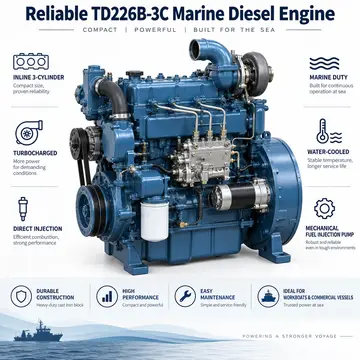
For larger boats and workboats, compact marine diesels in the 40–75 kW class, such as the TD226B-3C 40 kW marine engine, illustrate the size of engine involved; confirm on the data sheet whether a given model is supplied as a propulsion or constant-speed generator variant.
How much does a marine generator cost?
Marine generator price depends mainly on output, cooling type, whether a sound shield is included, control and paralleling features, class certification and emissions tier. Installation, exhaust, fuel lines and switchboard work can add substantially to the hardware cost, so compare quotations on the same scope.
MARS supplies diesel engines for genset builders and marine auxiliary use, run-tests engines with a written report and video before dispatch, and ships FOB or CIF Shanghai. To size and quote a set, send your load list and vessel details.
Frequently asked questions
What size marine generator do I need?
Add the running power of all loads that operate together, add the largest motor-starting surge, and choose a set whose prime rating puts normal load at about 50–80 percent. Small cruisers often need 4–8 kW; boats with several air-conditioning units commonly need 10–25 kW.
What is the difference between a marine generator and a regular generator?
A marine set uses heat-exchanger or keel cooling, a water-cooled exhaust, corrosion-resistant materials and safety shutdowns suited to an enclosed engine room. A land generator usually has radiator cooling and a hot, dry exhaust that is unsafe below deck.
What is an auxiliary engine on a ship?
An auxiliary engine is any engine aboard other than the main propulsion engine, most often the diesel engine driving a generator. Ships under SOLAS normally carry at least two auxiliary generating sets.
Can I run a generator at low load all the time?
Running a diesel generator for long periods below roughly 30 percent load can cause wet stacking, carbon build-up and fuel dilution of the oil. Choose a smaller set or add a harbor set if your base load is low.
Is kW or kVA used to size a boat generator?
Size the load in kW, then check the alternator's kVA rating covers motor loads; at a 0.8 power factor, kVA equals kW divided by 0.8. Motor-heavy loads can be limited by kVA and starting current rather than kW.