An industrial diesel generator is a generator set built around a heavy-duty, slow-revving diesel engine, typically running at 1500 rpm for 50 Hz or 1800 rpm for 60 Hz, coupled to a brushless alternator on a common base frame with a radiator, fuel system and control panel. It is rated under ISO 8528 for standby, prime or continuous duty and is chosen for factories, mines, construction sites, hospitals and data centers because it starts quickly, carries its own fuel and accepts large load steps.
Key takeaways
- An industrial diesel genset consists of an engine, alternator, base frame, cooling system, fuel system, controller and, usually, an enclosure and transfer switch.
- Industrial sets run at four-pole speed (1500 or 1800 rpm) rather than the 3000 or 3600 rpm common in small portable units, which extends engine life.
- The genset's standby, prime or continuous rating under ISO 8528-1 matters more than its headline kVA when comparing offers.
- Sound-attenuated canopies commonly reduce noise to roughly 65–75 dB(A) at 7 m, depending on design and size.
- In the US, stationary emergency diesel sets are generally limited to 100 hours a year for maintenance and testing, while non-emergency sets typically need cleaner, Tier 4 Final certified engines.
What are the main diesel generator components?
A diesel generator set is a package of matched subsystems. Knowing each one helps buyers compare quotations line by line.
| Component | What it does | What to check |
|---|---|---|
| Diesel engine | Converts fuel into shaft power | Genset prime and standby kW at 1500/1800 rpm, governor type, emissions certification |
| Alternator | Converts shaft power into electricity | kVA rating, insulation class, temperature rise, motor-starting kVA, AVR |
| Coupling and base frame | Join and support engine and alternator | Single or two-bearing alternator, anti-vibration mounts, integral fuel tank |
| Cooling system | Removes engine heat | Radiator ambient rating (e.g. 40 or 50 °C), or remote radiator / heat exchanger |
| Fuel system | Stores, filters and delivers fuel | Day or base tank capacity, primary filter with water separator |
| Controller | Starts, protects and monitors the set | Auto-start, protections, paralleling, remote monitoring |
| Enclosure | Protects against weather and reduces noise | Sound level at 7 m, access doors, corrosion protection |
| Transfer switch (ATS) | Switches load between utility and genset | Rating, transition type, number of poles |
The engine and alternator usually come from different specialist makers; the genset assembler matches them, adds controls and enclosure, and tests the package.
How do I choose a genset engine?
Choose the engine by its genset-specific rating, not by a truck, construction or marine rating of the same block. A diesel engine for a generating set is calibrated to run at constant synchronous speed, with a governor that holds frequency within tight limits, and its output is published as prime and standby kW at 1500 or 1800 rpm.
Points to compare:
- Rated output at your frequency. The same engine gives more power at 1800 rpm than at 1500 rpm, so a 60 Hz rating does not apply to a 50 Hz set.
- Governor. Mechanical governors are simple and field-repairable; electronic governors and engine ECUs give tighter frequency control, better load acceptance and easier paralleling.
- Displacement and aspiration. A larger, turbocharged and aftercooled engine typically holds load better and lasts longer than a small engine pushed to the same output.
- Emissions certification for the destination market, which may restrict which engines can be imported or installed.
- Parts and service access. Engines with a wide global parts network keep downtime low, which is why widely supported six-cylinder families dominate the 80–500 kW range.
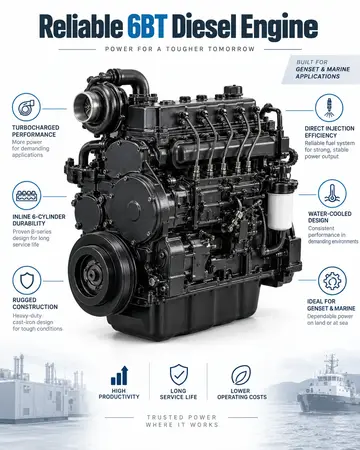
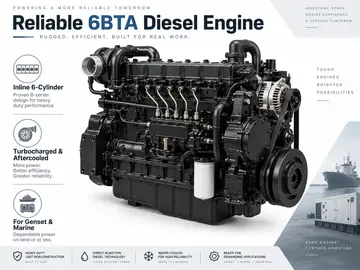
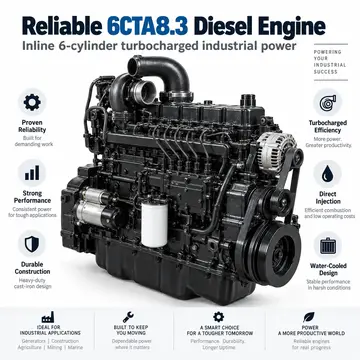
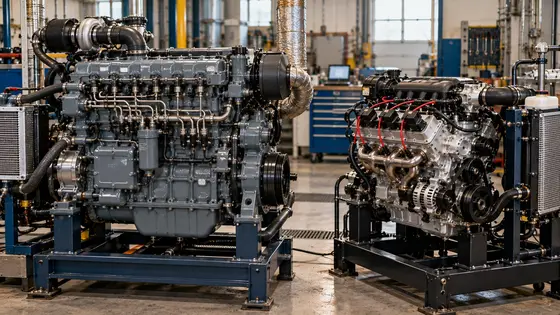
Common examples include the 6BT engine for gensets and marine use, the 6CTA8.3 engine and industrial engines such as the PU086TI industrial diesel.
Open, silent, containerized or mobile: which genset type fits?
The enclosure type follows the installation. Each has a different cost, footprint and noise level.
- Open-frame sets are installed in a dedicated plant room with ventilation and an exhaust system. They are the cheapest per kVA and easiest to service.
- Silent or sound-attenuated canopies house the set in a steel enclosure lined with acoustic foam, with baffled air paths and a residential-grade silencer. Quiet diesel generators suit hospitals, offices and urban sites.
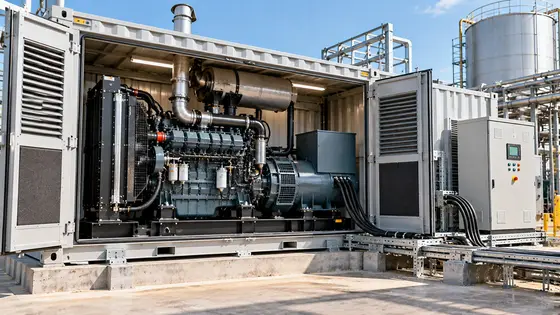
- Containerized sets, often in ISO 20 ft or 40 ft containers, suit large outputs, mining camps and temporary power plants, with switchgear and fuel inside.
- Mobile and towable gensets on a trailer serve construction, events and rental fleets. A diesel generator trailer typically has a bunded base tank and road-legal running gear.
For construction power and diesel generator hire, ruggedness, fuel autonomy and ease of transport usually matter more than lowest cost.
Which specifications should I read on a genset data sheet?
The data sheet tells you what the set can actually do. Read these items, in this order:
- Rating category and definition (standby, prime, continuous) and the site conditions at which it applies.
- kW and kVA at the stated power factor, normally 0.8 for three-phase sets.
- Voltage, frequency and phases, for example 400/230 V 50 Hz or 480/277 V 60 Hz.
- Performance class under ISO 8528, such as G2 or G3, which describes voltage and frequency deviation on load steps.
- Fuel consumption at 25, 50, 75 and 100 percent load.
- Altitude and temperature derating.
- Noise level at a stated distance for enclosed sets.
- Dimensions, wet weight and fuel tank autonomy.
If two offers show the same kVA but different rating categories, convert both to the same basis before comparing price. For a load-based method, see our guide to diesel generator sizing in kW and kVA.
Which emissions rules apply to an industrial diesel generator?
Emissions rules depend on where the set is installed and how it is used. In the United States, stationary engines fall under EPA rules (40 CFR Part 60 Subpart IIII for compression-ignition engines). Emergency sets are generally allowed with Tier 2 or Tier 3 certified engines and are limited to 100 hours a year for maintenance and testing, while non-emergency sets used for prime power or peak shaving typically need Tier 4 Final engines with aftertreatment. Local air boards may impose stricter limits.
In the EU, engines in mobile and transportable gensets fall under the Stage V non-road regulation, (EU) 2016/1628, while permanently installed plants are covered by separate rules. Many export markets have lighter requirements, but buyers should confirm what their customs and permitting authorities accept before ordering.
How do I maintain a commercial diesel generator?
A standby set that rarely runs still needs scheduled care, because most failures are found when the utility fails. Typical tasks include:
- Weekly or monthly exercise runs, ideally with real load or a load bank, to avoid wet stacking.
- Daily or weekly checks of coolant, oil, battery voltage and the fuel water separator drain.
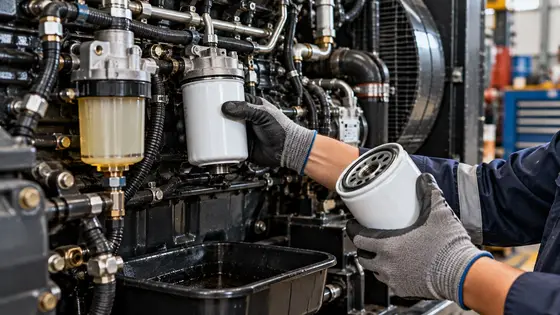
- Oil and filter changes, often every 250–500 running hours or annually, per the engine maker's schedule.
- Fuel testing and, where needed, polishing; stored diesel degrades and attracts water and microbes.
- Annual load testing and inspection of the transfer switch, cooling system and exhaust.
Keep a stock of filters and wear parts on site; see our guides to diesel fuel filter replacement and fuel water separators.
New, used or hired: what are the trade-offs?
A new set gives full warranty and known history. A second-hand diesel generator can cost much less but needs a load test, oil analysis and a check of alternator insulation before purchase, and its emissions certification may not meet current rules. Hire suits short projects, construction phases and emergency cover, while ownership pays off when the set runs every year.
Diesel genset price depends on rating category, engine and alternator make, enclosure, controls and emissions level, so compare offers only once the specification is aligned.
Custom genset solutions for assemblers and distributors
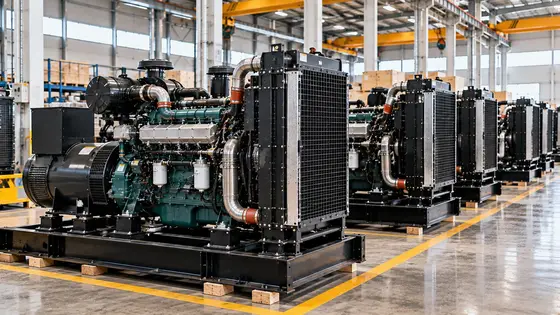
Many genset builders buy engines and assemble the alternator, base frame and enclosure locally. That model works when the engine supplier confirms the genset rating, flywheel and housing sizes (SAE numbers), radiator option and governor type before shipment. On the genset assembler project, engines were supplied with those details confirmed for local packaging.
MARS supplies genset engines FOB or CIF Shanghai in export wooden-box packing, with each engine run-tested and documented with a written report and video before dispatch. To check an engine against your alternator and rating, contact the engineering team.
Frequently asked questions
What is the difference between an industrial and a portable generator?
Industrial generators run at 1500 or 1800 rpm with heavy-duty diesel engines, three-phase alternators and automatic controls, and are rated for long hours. Portable units usually run at 3000 or 3600 rpm and are built for light, occasional use.
How long does an industrial diesel generator last?
Life depends on rating, load and maintenance. Well-maintained low-speed industrial engines commonly run for tens of thousands of hours before a major overhaul, but the engine maker's figures for the specific model apply.
What is a silent diesel generator?
It is a genset in a sound-attenuated enclosure with acoustic lining, baffled air paths and an efficient silencer. Noise levels are typically quoted in dB(A) at 7 m and vary by size and design.
What is a twin pack diesel genset?
A twin pack combines two gensets, often in one enclosure or container, that can run singly or in parallel. It gives redundancy and lets one set carry light loads efficiently while the other stands by.
Can a marine diesel engine be used for a generator?
Marine auxiliary engines are often used to drive generators on board, but they carry marine-specific ratings and cooling. For land-based gensets, choose an engine with a published genset rating.