A natural gas generator is usually the better choice when a site has reliable piped gas and the set will run many hours a year as prime, continuous or peak-shaving power, because fuel is cheaper per unit of energy in many markets, oil-change intervals are longer and emissions are lower. A diesel generator is usually the better choice for emergency standby, remote sites and mobile use, because it stores its own fuel on site, picks up large block loads quickly and typically costs less to buy for the same kW.
Key takeaways
- Natural gas gensets use spark-ignited reciprocating engines; diesel gensets use compression ignition and generally have higher power density for the same displacement.
- Diesel stores its fuel on site, while pipeline gas depends on the utility network, which matters for life-safety standby loads and must be accepted by the authority having jurisdiction.
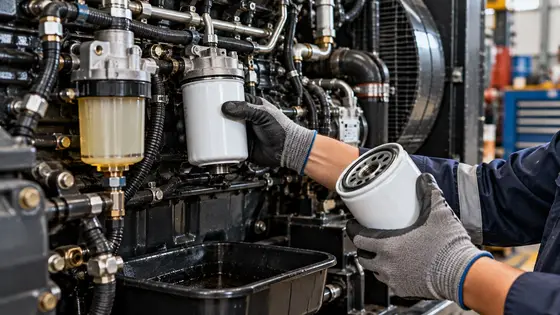
- Gas engines often run about 1,000 hours between oil changes in standby service, compared with roughly 250–300 hours typical for diesel, according to published manufacturer guidance.
- Lean-burn gas engines run with excess air for lower NOx and better efficiency; rich-burn gas engines need a three-way catalyst but have traditionally accepted load more easily.
- Diesel usually wins on first cost and infrequent standby use; gas tends to win on fuel and maintenance cost once annual run hours are high.
- For 60 Hz power a four-pole generator runs at 1800 rpm, and for 50 Hz at 1500 rpm, whichever fuel the engine burns.
How does a natural gas generator work?
It is a spark-ignited reciprocating engine coupled to an alternator. Gas is metered by a regulator and mixer or by port injection, mixed with air, compressed and ignited by spark plugs; the crankshaft turns the alternator at synchronous speed to produce electricity.
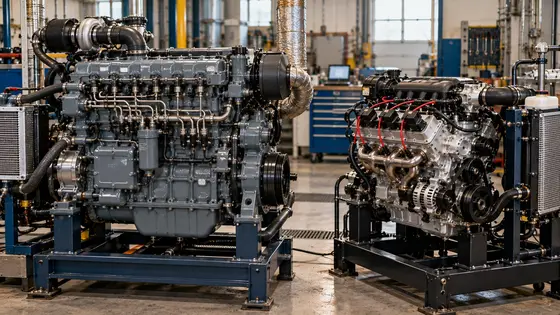
Many industrial gas engines are derived from diesel blocks. The block, crank and bearings are shared, but the head, pistons and compression ratio are changed, an ignition system replaces the injectors, and the engine gains a gas train, throttle and air-fuel ratio control. Because a spark-ignited engine must avoid knock, a gas version of a block usually carries a lower power rating than the diesel version of the same displacement.
Two combustion strategies dominate:
- Rich burn (stoichiometric): runs at the chemically correct air-fuel ratio. Higher exhaust temperature and NOx, so a three-way catalyst is normally needed, but load pickup is traditionally good.
- Lean burn: runs with excess air, which lowers combustion temperature and NOx and typically improves fuel efficiency. Modern lean-burn engines use turbocharging and fast controls to improve load acceptance.
Natural gas vs diesel generator: how do they compare?
The two fuels suit different duty profiles. The table summarizes the typical trade-offs; individual models vary, so check the genset data sheet.
| Factor | Natural gas genset | Diesel genset |
|---|---|---|
| Ignition | Spark ignition | Compression ignition |
| Fuel supply | Utility pipeline, CNG or LNG, field gas, biogas | Stored on site in a base or day tank |
| Fuel storage issues | None on site for pipeline gas | Fuel ages and needs testing and polishing |
| Block load acceptance | Good on modern standby-designed engines, model dependent | Traditionally the strongest |
| Power density | Lower per liter of displacement | Higher |
| First cost per kW | Usually higher | Usually lower, especially where Tier 2 or equivalent is allowed |
| Oil change interval | Often around 1,000 h | Often 250–500 h, model dependent |
| Emissions | Lower particulates and NOx, especially lean burn | Needs aftertreatment for strict non-emergency limits |
| Best fit | Prime, continuous, CHP, peak shaving | Emergency standby, remote, mobile, marine |
Is a natural gas backup generator reliable enough for standby?
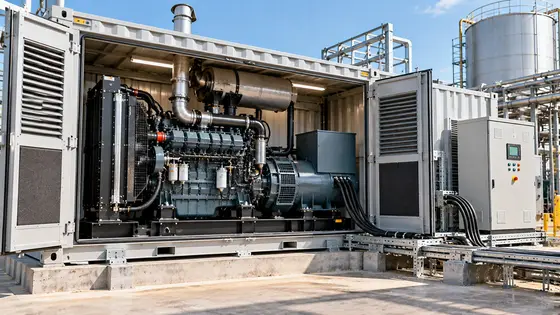
Yes, for many commercial sites, but the fuel source must be acceptable to the code authority. NFPA 110 Type 10 systems must restore power within 10 seconds, and current gas gensets from major makers can meet that, although load pickup capability still varies more between gas models than between diesel models.
The bigger question is fuel security. A natural gas standby generator relies on the pipeline staying pressurized during the outage. Utility gas often survives storms and floods better than diesel delivery logistics, yet earthquakes or deliberate shut-offs can interrupt it. For hospitals and other life-safety loads, the design engineer, the gas utility and the authority having jurisdiction typically need to agree that utility gas counts as a reliable source. Where that is not accepted, diesel or a dual-fuel arrangement is the usual answer.
Where do natural gas gensets make the most sense?
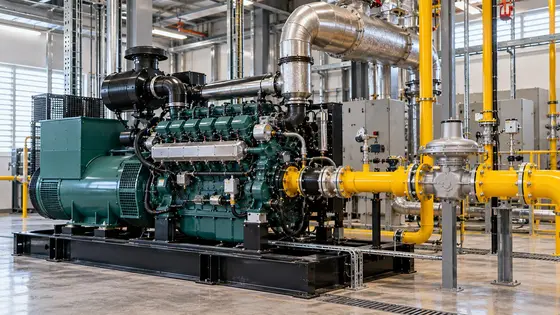
Natural gas gensets pay off where run hours are high and gas is cheap and available. Typical applications include:
- Prime power for oil and gas sites, where field or associated gas that would otherwise be flared fuels the engine. Gas quality, methane number and heating value must be checked, and engines are often derated on rich or sour gas.
- Combined heat and power (CHP) at factories, greenhouses and hotels, recovering jacket-water and exhaust heat.
- Peak shaving and demand response, where sets run during high-tariff periods.
- Biogas and landfill gas projects, usually with gas cleaning and a dedicated engine rating.
- Commercial standby where the authority accepts pipeline gas and owners want to avoid diesel fuel maintenance.
Diesel remains the default for remote mines, construction power, ships and offshore units, and any site where fuel must be carried in.
Reciprocating engine or natural gas turbine?
For most projects below a few megawatts, a reciprocating engine is the usual choice. A natural gas turbine generator is compact and light for its output and suits large continuous plants and combined-cycle gas power plants, but simple-cycle turbines lose efficiency at part load and are sensitive to ambient temperature. Gas engines, by contrast, hold efficiency well at partial load and can be installed in multiples so units are switched on and off to follow demand.
That modular approach is why many gas generation plants of several megawatts are built from multiple engine-generator sets of 1 MW or more rather than one turbine. Large generator buyers should compare part-load efficiency, start time, maintenance and the local service network, not only nameplate output.
How much does a natural gas generator cost to own?
Total cost depends more on run hours than on purchase price. A gas set usually has a higher first cost per kW than a diesel set, plus gas-line, regulator and permitting costs, but lower fuel and maintenance costs per running hour in many regions. Diesel is often cheaper overall when the set runs only for testing and occasional outages.
The main cost drivers are:
- Rating and size: a 20 kW unit and a 2 MW unit are entirely different products, and price per kW falls as size rises.
- Emissions requirements: in the US, emergency diesel sets can generally use Tier 2 or Tier 3 certified engines, but non-emergency diesels typically need Tier 4 Final, which adds aftertreatment and narrows the cost gap with gas.
- Fuel price ratio between pipeline gas, CNG and diesel in your market.
- Annual run hours, which multiply the fuel and maintenance difference.
- Enclosure, controls and paralleling switchgear.
As a rough guide to fuel use, a diesel genset at good load typically burns around 0.25 liters per kWh, while a mid-size gas genset typically needs roughly 0.3 cubic meters of pipeline gas per kWh. Both figures vary with model, load and gas quality, so use the data-sheet consumption curves for any business case. Pipeline gas averages roughly 1,000 Btu per standard cubic foot (about 37 MJ per cubic meter), but the actual heating value varies by supply.
Can you run a generator on compressed natural gas?
Yes. Compressed natural gas is typically stored at about 200–250 bar (3,000–3,600 psi) and reduced through a regulator to the low pressure the engine requires. CNG trailers are used for temporary or bridging power where no pipeline exists, and LNG can serve larger prime-power sites, although LNG boil-off makes it a poor fit for long-idle standby. CNG fueling infrastructure built for natural gas trucks and buses rarely helps a stationary genset directly; most sites take pipeline gas.
Choosing the engine for a natural gas genset
For genset builders, the engine decides the rating, the gas-quality limits and the service plan. Check these points before ordering:
- Rated power at 1500 or 1800 rpm, prime or continuous, at your altitude and ambient temperature.
- Minimum methane number and gas supply pressure at the engine inlet.
- Ignition, air-fuel ratio control and governor compatibility with your controller.
- Spark plug and oil change intervals and parts availability.
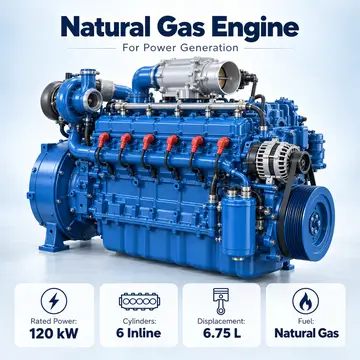
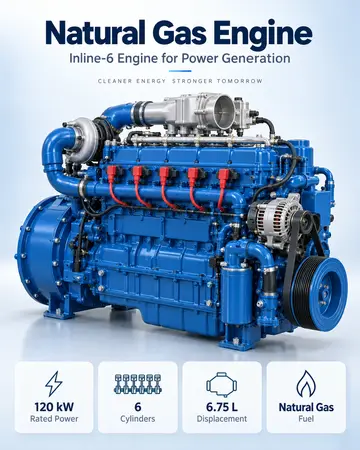
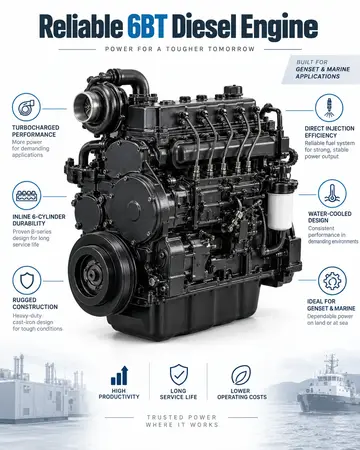
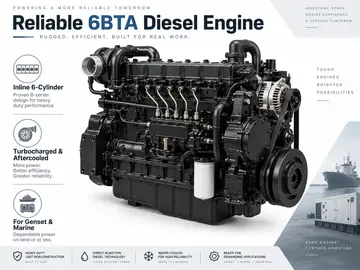
A mid-range example is the 120 kW natural gas engine on the WP6 platform, a six-cylinder unit used for gensets and gas-powered equipment; the natural gas genset project shows how such engines were supplied to an assembler. For diesel builds, six-cylinder engines like the 6BT genset and marine engine remain common. Compare more options on the gas engines and diesel engines pages, and see our guide on how to size a diesel generator.
MARS supplies gas and diesel genset engines FOB or CIF Shanghai, and each engine can be run-tested with a written report and video before dispatch. To confirm a rating against your gas analysis, send your project details.
Frequently asked questions
Is a natural gas generator better than diesel?
Neither is better for every job. Natural gas usually wins for long run hours where piped gas is available, while diesel usually wins for emergency standby, remote sites and lowest first cost.
How long can a natural gas generator run?
On a reliable pipeline supply it can run as long as the engine rating and maintenance plan allow, since there is no tank to refill. A prime or continuous rating is required for long unattended run times.
Can a diesel generator be converted to natural gas?
A diesel generator can be fitted with a dual-fuel kit that substitutes part of the diesel with gas after warm-up, but it still needs diesel to ignite. Full conversion to spark-ignited gas operation needs new heads or pistons, ignition and controls, and is rarely economic.
What size natural gas genset do I need?
Size it like any genset: total the running kW, add motor starting loads, and convert to kVA at 0.8 power factor. Then check that the chosen gas model's transient response meets your largest block load.
What is an 1800 rpm natural gas generator?
It is a four-pole set producing 60 Hz power, typical in North America. Slower-running 1800 rpm and 1500 rpm sets are preferred for prime and continuous duty because they run cooler and wear more slowly than 3600 rpm sets.