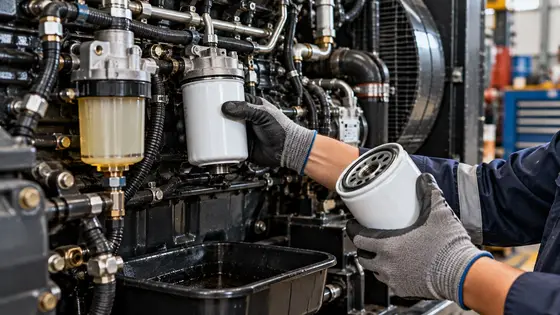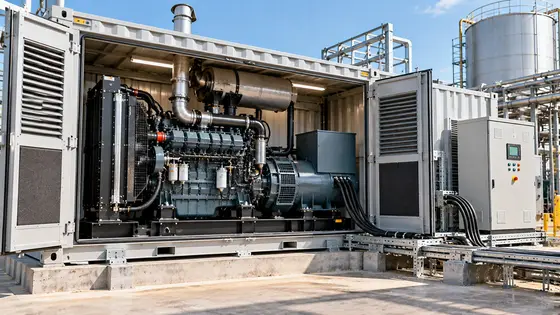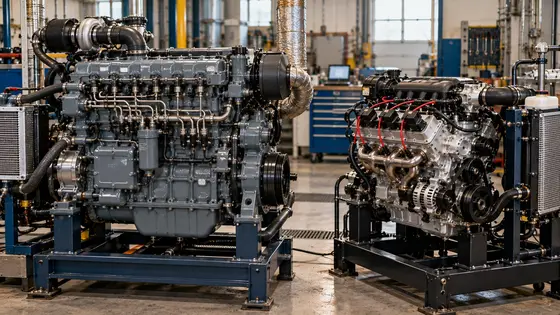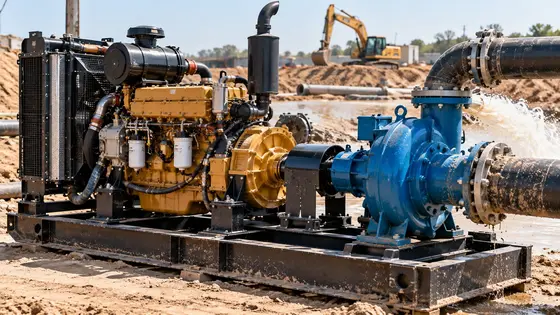
Industrial diesel engines are heavy-duty compression-ignition engines built to drive generators, pumps, compressors and construction, mining and agricultural machinery for long hours at steady load. They are typically 4- or 6-cylinder inline or V engines from about 30 kW to well over 500 kW, rated to standards such as ISO 3046-1, and chosen on duty rating, rated speed, emissions compliance and parts support rather than headline horsepower.
Key takeaways
- An industrial diesel engine is defined by its duty, not its size: it is rated for long hours at sustained load, unlike most automotive engines.
- ISO 3046-1 sets how engine power is declared under standard reference conditions of 100 kPa, 25 °C and 30 percent relative humidity; ISO 8528-1 defines genset ratings such as continuous, prime and emergency standby.
- Reliability comes mainly from conservative ratings, large displacement per kilowatt, replaceable cylinder liners and good filtration, not from brand reputation alone.
- Mechanical-injection engines are simpler to repair in the field; electronic common-rail engines are cleaner and more efficient but need diagnostics.
- Engines sold into new equipment in the US and EU must meet EPA Tier 4 or EU Stage V nonroad limits for their power band.
What is an industrial diesel engine?
An industrial diesel engine is a stationary or off-highway engine designed to deliver its rated power for thousands of hours with predictable wear. It is sold either as a bare engine, as a power unit with radiator and clutch, or built into a genset or machine.
Most share a common heritage with truck or marine engines, but the industrial version differs in calibration, governor, cooling package and rating. A heavy duty diesel engine for a wheel loader, for example, is tuned for strong torque rise at falling rpm, while the same block in a generator runs at a fixed 1,500 or 1,800 rpm with a tight speed governor.
What are the main types of diesel engines in industry?
Industrial diesels are classified by several features at once. The table summarizes the kinds of diesel engine buyers meet most often.
| Classification | Main types | What it means for the buyer |
|---|---|---|
| Rated speed | High-speed (above about 1,000 rpm), medium-speed (about 300–1,000 rpm) | High-speed engines are compact; medium-speed engines are heavier and very long-lived |
| Cylinder layout | Inline 3, 4 or 6; V8, V12, V16 | Inline 6 is the industrial workhorse; V engines pack more power into less length |
| Aspiration | Naturally aspirated, turbocharged, turbocharged and aftercooled | Turbocharging and aftercooling raise power per liter and improve efficiency |
| Fuel injection | Mechanical pump, unit injector, electronic common rail | Mechanical is simpler; common rail is cleaner and quieter |
| Cooling | Radiator, heat exchanger, air cooled | Radiators dominate on land; heat exchangers on boats; air cooling on small engines |
| Application | Genset, construction, agricultural, pump and compressor, marine | Each has its own calibration, rating and accessories |
For background on combustion and the four-stroke cycle, see how a diesel engine works. Small engines below about 75 kW are covered in the small diesel engines guide.
How are industrial diesel engines rated?
Industrial engine power is only meaningful with its rating definition. ISO 3046-1 defines how power, fuel consumption and lubricating oil consumption are declared under standard reference conditions, and requires the maker to state how power is derated for altitude and temperature.
Generator sets use ISO 8528-1 ratings, which tell you how many hours and at what average load the engine may run:
| Rating (ISO 8528-1) | Typical meaning | Typical use |
|---|---|---|
| Continuous operating power (COP) | Constant load, unlimited hours | Base-load power plants, mines with no grid |
| Prime rated power (PRP) | Variable load, unlimited hours, average load limited (commonly about 70 percent) | Off-grid sites, construction power |
| Limited-time running power (LTP) | Constant load for a limited number of hours per year | Peak shaving |
| Emergency standby power (ESP) | Variable load during grid outages only, limited annual hours | Hospitals, data centers, buildings |
For machinery, makers commonly publish continuous and intermittent ratings. Always compare engines on the same rating, at the same speed and the same ambient conditions; a standby figure set against a prime figure is not a fair comparison. The diesel generator sizing guide explains how to apply these ratings to kVA.
What makes the most reliable diesel engine?
The most reliable diesel engines share design traits rather than a single brand. When buyers ask "which diesel engine is better" for industrial work, the answer is usually the one that is lightly stressed for the job and easy to maintain.
Look for these features:
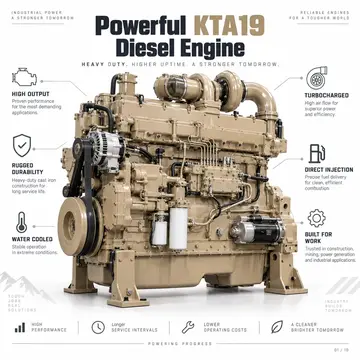
- Low specific output. More displacement per kilowatt means lower cylinder pressure and slower wear. A 600 hp engine of about 19 liters, such as this 448 kW industrial six-cylinder, is far less stressed than a smaller engine tuned to the same power.
- Moderate rated speed. Engines rated at 1,500–2,100 rpm generally last longer under steady load than those rated much higher.
- Replaceable wet liners and a rebuildable bottom end, so an overhaul restores the engine instead of scrapping the block.
- Robust filtration and cooling, sized for dusty or hot sites.
- Proven parts supply where the engine will operate. A well-supported mid-range engine often outperforms an exotic one simply because spares arrive quickly.
The engines often called the "best diesel engines ever made" tend to be simple mechanical inline sixes with large production volumes and global parts networks. Conversely, the reputations of the "worst diesel engines" usually trace back to new technology rushed into service, aggressive ratings or poor fuel and maintenance conditions.
Are mechanical diesel engines better than electronic ones?
Mechanical diesel engines are better where repair skills and diagnostic tools are limited, and where emission rules allow them. Electronic common-rail engines are better where emissions limits, fuel economy and noise matter.
Mechanical engines tolerate lower fuel quality, can be repaired with basic tools, and are still widely used in gensets, marine and machinery exported to markets without strict nonroad limits. Electronic engines meet EPA Tier 4 and EU Stage V limits with aftertreatment, deliver better transient response and give fault codes, but they need clean fuel, the right diagnostic software and careful handling of sensors and wiring. Many fleets keep mechanical engines in remote service and use electronic engines where regulations require them.
Which diesel engine manufacturers and brands should you consider?
The diesel engine market includes long-established global manufacturers from North America, Europe, Japan and Korea, and large Chinese manufacturers, several of which also build engines under license or through joint ventures. Rather than choosing by name, compare the specific engine model against your application.
Questions to ask any manufacturer or supplier:
- Is the engine certified for the emission rules in the destination country?
- What is the published rating definition, and does it match your duty cycle?
- What is the expected interval to major overhaul under that rating?
- Are parts, service manuals and trained technicians available locally?
- Can the engine be tested on a dynamometer or load bank before shipping?
The comparison of Chinese diesel engine brands covers the main Chinese makers' families in detail.
How do I choose an industrial diesel engine?
Choose from the load backwards. A structured selection avoids buying a cheap diesel engine that turns out expensive in downtime.
- Define the load: power at the driven shaft, speed, and whether the load is steady (generator, pump) or variable (loader, crusher).
- Pick the rating: continuous, prime or standby for gensets; continuous or intermittent for machinery.
- Correct for site conditions: derate for altitude and high intake temperature per the maker's curves.
- Check emissions compliance for the country of use.
- Match the installation: flywheel housing (SAE size), flywheel, PTO, cooling package and dimensions.
- Plan support: filters, overhaul kits and a service schedule before the engine arrives.
| Typical application | Common power range | Engine type often used |
|---|---|---|
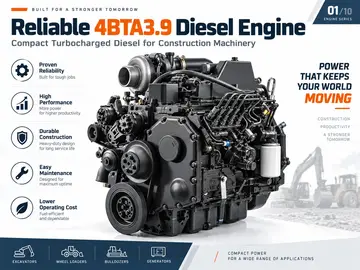
| Compact construction and compressors | 50–100 kW | Turbocharged 4-cylinder, about 4 liters |
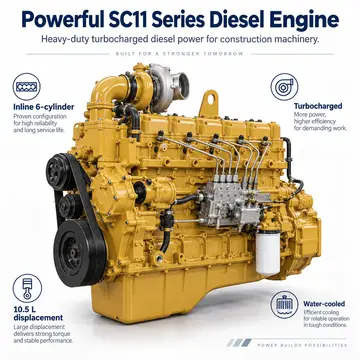
| Wheel loaders and excavators | 100–200 kW | Turbocharged inline 6, about 7–10 liters |
| Prime-power gensets | 80–500 kW | Inline 6 or V engines, 6–19 liters |
| Mining equipment and large pumps | 300–600 kW | Large inline 6 or V12 |
For construction machinery, an industrial six-cylinder for 135–200 kW machines is typical. The construction machinery engine project shows how a fleet of excavators and loaders was re-engined.
Buying from a diesel engine supplier
Working with an export supplier rather than a single factory lets buyers source several engine families in one order. Shanghai Mars Industrial (MARS) supplies industrial, genset, marine and truck diesel engines, matches the engine to the application, and can run-test each engine before dispatch with a written report and video, packed in export wooden boxes FOB or CIF Shanghai. Request a quotation with your application, power and rating.
Frequently asked questions
What is the difference between an industrial and an automotive diesel engine?
An industrial diesel is rated for long hours at sustained load and calibrated for its machine, while an automotive diesel is optimized for variable road load, low weight and emissions in vehicle tests. Industrial ratings are therefore more conservative for the same block.
Are diesel engines more reliable than gasoline engines in industry?
Generally yes for heavy, long-hour duty, because diesels run at lower speed with stronger components and no spark ignition system. Reliability still depends on correct rating, clean fuel and maintenance.
What does a heavy duty diesel engine mean?
It usually means an engine built for high loads and long life, typically with replaceable cylinder liners, a forged crankshaft and an overhaul-friendly design. The term is not formally standardized, so check the rating and expected overhaul interval.
Can I swap a different diesel engine into my machine?
Often yes, but you must match power, speed, flywheel housing, mounts, cooling capacity, hydraulic pump drive and emissions rules. A supplier can check these points against your old engine's data before quoting.
How long do industrial diesel engines last?
Well-maintained heavy-duty industrial diesels commonly run many thousands of hours before a major overhaul, and can be rebuilt several times. The exact figure depends on rating, load factor and maintenance, so ask the maker for the expected interval.